The Moment
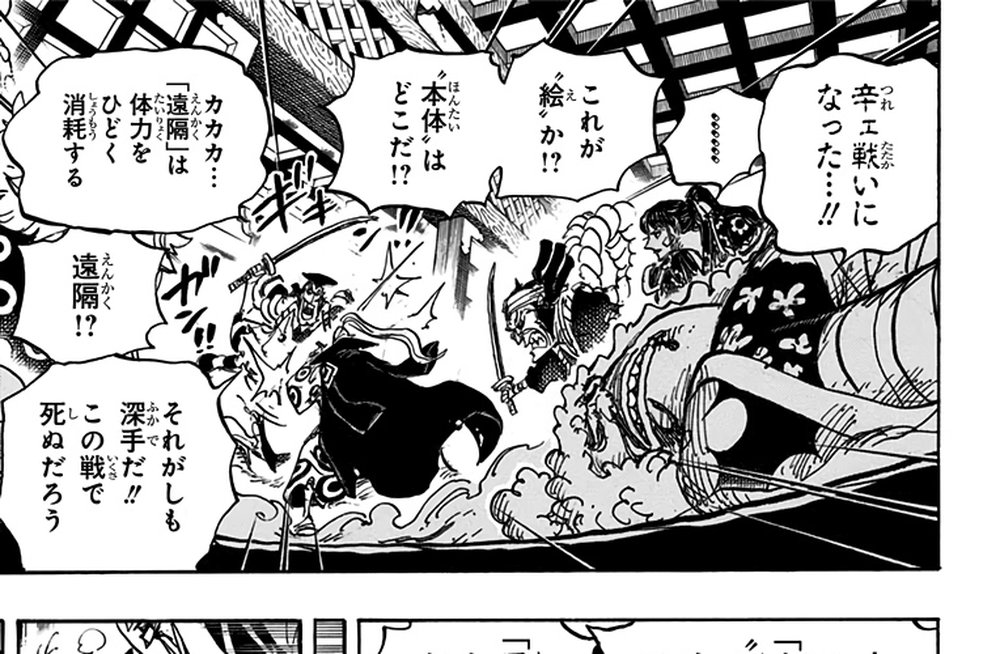
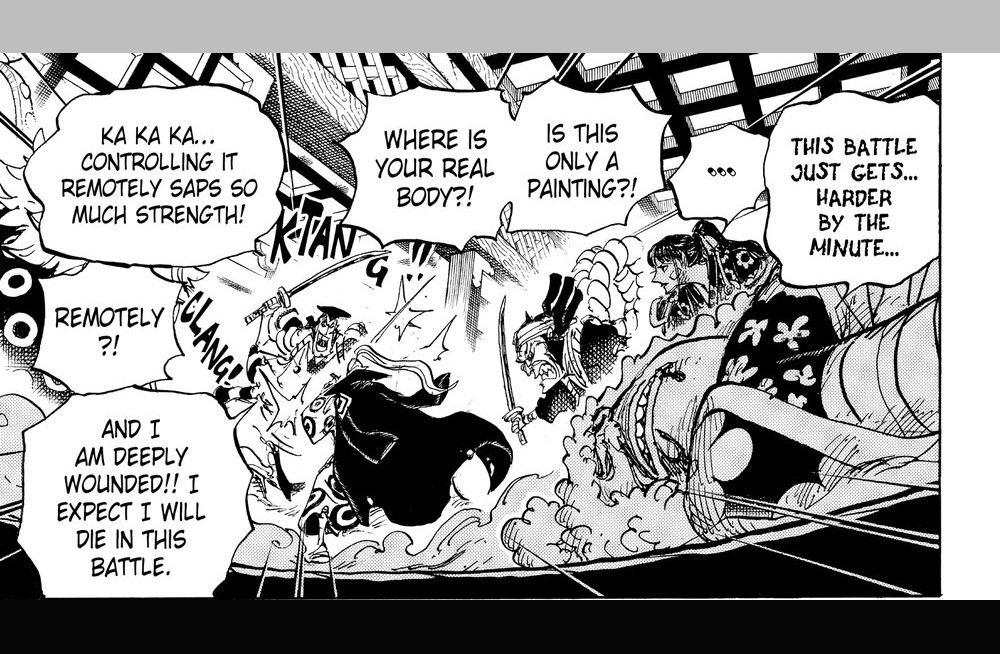
The raid on Onigashima. Kurozumi Kanjuro's true colors are already out: years of posing as a loyal Wano samurai and Straw Hat ally have collapsed into the reveal that he's been the shogun's spy the whole time. Cornered, he does what his Devil Fruit lets him do — sends out a life-size paper decoy of himself to keep a swordsman busy while the real Kanjuro slips toward Momonosuke, the last heir of the Kozuki clan. Facing the decoy down is Izo, a former Whitebeard Pirates commander and one of the Akazaya Nine, sword drawn, demanding to know where the real body is. Battered, the decoy turns and answers with a lie dressed in perfect old-world grammar:
「それがしも深手だ!!この戦で死ぬだろう」
Soregashi mo fukade da!! Kono ikusa de shinu darō.
VIZ's English edition prints: "AND I AM DEEPLY WOUNDED!! I EXPECT I WILL DIE IN THIS BATTLE." (Vol. 100 — landing on p.69 of the VIZ tankobon, two pages ahead of where the Japanese edition prints the same panel; VIZ's repagination shifts this whole sequence forward. See VIZ's Choice below.)
Grant the rendering its due: as a flat statement it's accurate, weighty, and reads exactly like something a dying man would say. The trouble is that this dying man is lying, in the same stiff, formal register he's used the entire time he's been on the page — and English has no way to flag that the diction itself is part of the performance.
The decoy isn't finished. In the next breath it drops all pretense of humility and announces exactly what it's been hiding:
「だがその前にー「光月家」の心臓は突いて死ぬ!!!「黒炭カン十郎」としてな!!」
VIZ: "AS KUROZUMI KANJURO!! BUT I WILL DIE HAVING PIERCED THE VERY HEART OF THE KOZUKI CLAN!!!"
The genial, sake-loving "Evening Shower Kanjuro" that Wano's samurai had trusted for years turns out to have been Kurozumi Kanjuro, Orochi's spy, the entire time — and even naming his own treason out loud, he never once drops それがし.
The Original
それがし is built from それ — "that, that one," a distal, indefinite pointer — plus がし, a fossilized suffix that also survives in 何がし (nanigashi, "such-and-such, someone or other"). The compound's oldest sense is simply a certain, unspecified one — the same shrug of vagueness you'd use to describe a stranger passing by — turned inward to mean this unspecified person here, i.e., me. Naming yourself as literally un-named is the humility baked into the word: even Kanjuro, mid-boast about his own sorcery, is grammatically calling himself "some fellow or other."
Formal orthography compresses all of that into a single kanji: 某, "a certain; so-and-so" — the same 某 alive today in 某氏 ("Mr. So-and-so") or 某国 ("a certain country"). Tellingly, neither of Kanjuro's lines in the volumes on file spells it that way. Manga dialogue almost always writes the pronoun out in plain hiragana, それがし, keeping the archaic sound without asking the reader to parse the kanji — the word is doing an audio job, not a literary one.
Place it on Japanese fiction's ladder of humble first-person pronouns and それがし sits at the antique end: older and dustier than 拙者 (sessha, "this unskilled one"), the samurai-humble "I" our Naruto sister article covers — spoken there, memorably, by a talking ninja dog. Where 拙者 was still common in real Edo-period speech, それがし was already receding by then, a medieval holdover kept alive from the Muromachi and Sengoku periods purely by inertia and, eventually, purely by fiction. Grammatically the headline sentence is nothing exotic — [それがし + も ("also") + 深手だ ("[am] gravely wounded")], then [この戦で ("in this battle") + 死ぬだろう ("will probably die")] — the weight is 100% in the pronoun, 0% in the syntax around it.
VIZ's Choice
Every それがし we found spoken in-story across the volumes on file, JP against VIZ's English:
| Vol. / p. (JP) | Japanese | VIZ English | Vol. / p. (VIZ) |
|---|---|---|---|
| 76 / 27 | それがしの妖術があれば | BESIDES, WITH MY SORCERY... | 76 / 27 |
| 100 / 71 | それがしも深手だ!!この戦で死ぬだろう | AND I AM DEEPLY WOUNDED!! I EXPECT I WILL DIE IN THIS BATTLE. | 100 / 69 |
Two occurrences, twenty-four volumes apart, and both times VIZ's solution is identical: plain "I." In Vol. 76, Kanjuro gets his own character-introduction splash page — full-body portrait, name-plate banner reading 「ワノ国の侍 夕立ちカン十郎」 ("Samurai of Wano — Evening Shower Kanjuro") — and uses the panel to brag: それがしの妖術があれば食う物にも困りはせぬのでな!! ("With それがし's sorcery, I'll never lack for food!!"), munching on a rice ball he's just conjured from a painting. It's a punchline. Twenty-four volumes later, the same pronoun carries his most consequential lie. VIZ's "I" is correct both times and identical both times — which is exactly the problem: the Japanese reader hears the same costume in the joke and in the con, and the English reader hears nothing connecting them at all.
One more wrinkle, flagged here for the record (see the ALIGNMENT SANITY CHECK note in our sourcing rules): the bilingual corpus pairing for the Vol. 100 line returned no English at all — a null alignment, not a wrong one. The true VIZ rendering above was confirmed by hand against the actual VIZ page image, which also revealed that VIZ's tankobon prints this whole sequence two pages earlier than the Japanese edition (p.69 vs. p.71) — almost certainly a difference in how bonus/color pages are counted between editions, not an edit to the story itself.
The Gap
The register vanishes into "I." それがし tells a Japanese reader, before the sentence even finishes, that the speaker is male, samurai-class or old-world formal, and antique enough to belong in a jidaigeki. English's "I" carries precisely none of that. The translator's only lever left is the sentence around the pronoun — and "AND I AM DEEPLY WOUNDED!! I EXPECT I WILL DIE IN THIS BATTLE." is stately, but stateliness reads as this moment is serious, not this speaker always talks like this.
The built-in humility disappears. それがし's root sense — "some unspecified one" — formally lowers the speaker even when the content isn't humble at all, as in the sorcery boast. English "I" carries no such undertow, so a line that in Japanese has a wink of self-deprecation built into its grammar reads, in English, as straight self-congratulation.
The performer's continuity goes dark. Kanjuro's それがし is identical whether he's showing off a magic trick or lying about his own death. That sameness is the entire point — a professional actor's voice doesn't change registers between a stage trick and a genuine crisis, because for him there may not be a difference. English's plain "I" gives the reader no way to notice that the punchline and the deathbed lie are performed in exactly the same voice.
English's toolbox proves the fix was available — and unused here. Moments earlier, on the very same page, Izo blames himself for letting Kanjuro escape using 拙者: 「拙者のせいです」. VIZ answers with "THIS ONE FAILED TO FINISH OFF KANJURO FOR GOOD!!" — reaching for the stilted, faintly archaic "this one" instead of a plain "I." It's the rare moment in this entire sequence where English marks an antique pronoun as antique. Kanjuro, one tier further back in the very same register cluster, gets no equivalent treatment — an inconsistency that costs the reader the age-gap between the two pronouns.
What If
No fix is free; here's the menu and its prices.
- "This unworthy one is gravely wounded..." — borrows the literal, self-lowering shape our Naruto sister article uses for 拙者. Cost: reads as translator-ese, not natural English dialogue.
- Keep "I," but salt the whole line with dated diction: "I am grievously wounded, and shall die in this battle." — spreads the archaism across the sentence instead of the pronoun. Cost: solemn where Kanjuro's other それがし line (the sorcery boast) is comic, so one solution doesn't fit both scenes.
- "Yours truly is not long for this world..." — a wry, theatrical English idiom that gestures at Kanjuro's identity as a performer. Cost: too knowing and modern-slangy for a battlefield deathbed line.
- Borrow VIZ's own fix for the neighboring 拙者 line — "this one" — for それがし too: "This one is gravely wounded..." Cost: would make それがし and 拙者 read identically in English, erasing the very age-gap between the two pronouns that makes them worth telling apart.
The deeper problem every option runs into: English has exactly one first-person pronoun to spend, and Japanese fiction has built an entire wardrobe out of the fact that it has several. There is no single English word that can do what それがし does; every fix has to spend extra words to buy back what one syllable-string gave the Japanese reader for free.
Take-away
それがし is hard to translate not because it's obscure but because its whole job is to be heard as a costume — one so old that, by the time Oda hands it to a professional kabuki performer, the joke practically writes itself. When a translation gives you plain "I" for a pronoun built to announce "this person is acting," the performance is still there in Japanese; it's just been left off the English stage.
Three rules of thumb to carry off this page:
- When you meet an unusual 一人称 (first-person pronoun) in Japanese fiction, ask what decade — or century — of speech it's borrowed from. The answer is almost always the point.
- それがし and 拙者 aren't interchangeable synonyms; they're adjacent rungs on the same ladder. Losing the gap between them loses information, even when both get flattened to the same English "I."
- Watch for characters whose profession already involves performance — actors, con artists, kabuki entertainers. An archaic pronoun in their mouth is rarely just world-building; it's usually a clue.
For two more corners of Japanese's first-person cast on this hub, see わし, the crusty village-elder "I" English also flattens to plain "I" and あたい, the tomboy street "I" that meets the same fate. それがし's own slightly younger cousin, 拙者, gets its own article on our Naruto site — spoken, unforgettably, by a talking ninja dog named Pakkun — though that hub isn't live yet, so no link here. Or browse the One Piece translation notes index.
Every Japanese line quoted above is a byte-exact capture from the cited edition — ONE PIECE Vol. 76 & Vol. 100 (Japanese) — via our bilingual page database; the corresponding VIZ Media English lines were confirmed directly against the published page images at Vol. 76, p.27 and Vol. 100, p.69, after the bilingual corpus's automatic page-pairing broke down for the Vol. 100 occurrence (see Sources below and the alignment note above).