The Moment
Volume 20's flashback chapter pulls all the way back to childhood: before Kokushibo, before Upper Rank One, before six centuries of envy, there were two boys — Sengoku-era twins Michikatsu and Yoriichi Tsugikuni — and one of them could not speak. From infancy Yoriichi never smiled, and until he turned seven the household assumed he was deaf, because he made no sound at all.
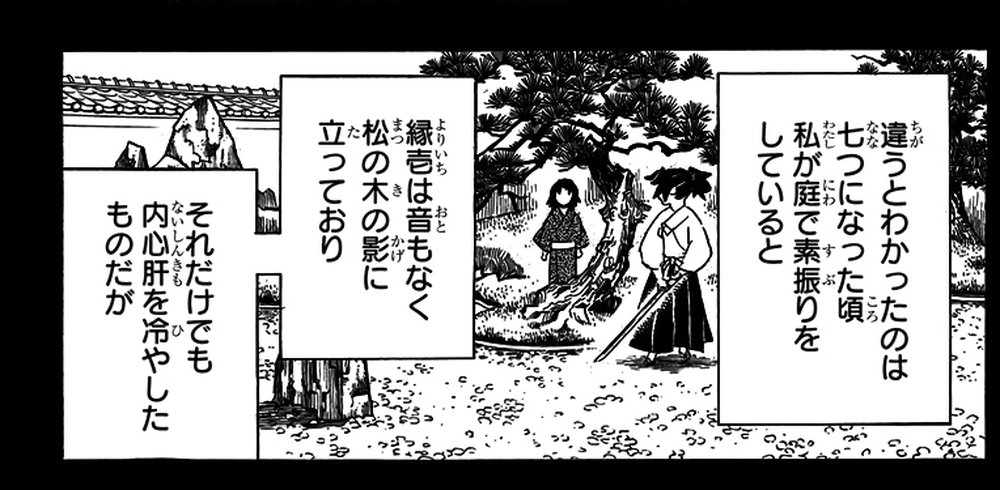
Then, one afternoon, Michikatsu is out practicing sword swings alone in the garden:
「違うとわかったのは七つになった頃私が庭で素振りをしていると/縁壱は音もなく松の木の影に立っており」
Chigau to wakatta no wa nanatsu ni natta koro watashi ga niwa de suburi o shite iru to / Yoriichi wa oto mo naku matsu no ki no kage ni tatte ori
Nothing has happened. No threat, no sound — just a silent boy, standing under a pine tree, watching. And Michikatsu's grown narration admits what that stillness did to him:
「それだけでも内心肝を冷やしたものだが」
Sore dake demo naishin kimo o hiyashita mono da ga
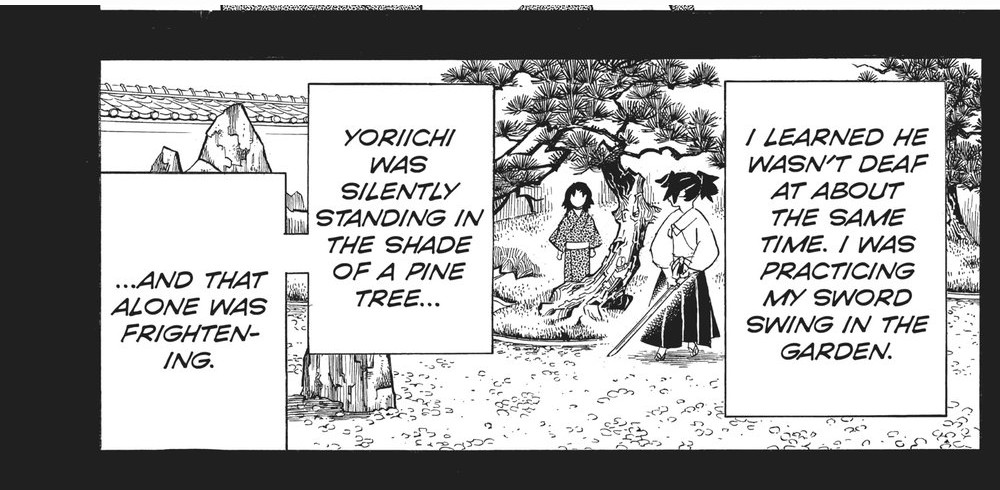
VIZ's English edition prints: "...AND THAT ALONE WAS FRIGHTENING." (Vol. 20, p.154 — this stretch of the volume runs the English edition one printed page behind the Japanese, so the corpus's machine alignment pairs this Japanese line with an empty English cell; the true VIZ rendering sits on p.154, confirmed directly against the printed page.)
Grant the line its due: "frightening" isn't wrong, and the sentence around it — "YORIICHI WAS SILENTLY STANDING IN THE SHADE OF A PINE TREE... ...AND THAT ALONE WAS FRIGHTENING." — reads cleanly, keeps それだけ's proportion ("that alone"), and lands the beat exactly where the panel needs it. But underneath "frightening," the Japanese is doing something much stranger: it is naming an organ, and telling you what happened to its temperature.
The Original
肝を冷やす (kimo o hiyasu) breaks into two ordinary pieces that add up to something English doesn't have a slot for.
肝 (kimo) is the liver. In the classical Chinese five-organ body-map that Japanese absorbed wholesale, each organ has a psychological job, and the liver's is nerve: courage, boldness, the capacity to hold steady under pressure. That is why Japanese courage-vocabulary keeps returning to it — 肝が据わる ("the liver sits firmly seated": unshakeable composure), 肝っ玉 ("liver-ball": guts, nerve), 肝が太い ("thick-livered": fearless), 度肝を抜く ("to yank someone's liver clean out": to flabbergast), 肝に銘じる ("to engrave something on the liver": to never forget an instruction). The liver, in this vocabulary, is not a punchline organ the way it sometimes is in English ("liverish," bad-tempered); it is the seat of your nerve, and idioms report on its condition the way English idioms report on your heart or your gut.
冷やす (hiyasu) is the transitive partner of 冷える (hieru, "to go cold"). It is the verb you use for chilling a drink, cooling a hot room, or — idiomatically — calming an overheated temper (頭を冷やす, "cool your head"). Put the two together and 肝を冷やす is, word for word, "to chill the liver": something external drops the temperature of the organ that holds your nerve, and the chill you feel is fright. There is an intransitive twin, 肝が冷える ("the liver itself goes cold"), used when the fear seems to originate in the organ rather than being done to it by circumstance — a difference of grammatical voice, not of meaning.
The sentence around the idiom adds two more small, precise words. 内心 (naishin), "inwardly, in one's heart," specifies that none of this showed — Michikatsu's face gave nothing away; the chill was private. それだけでも, "even just that," sets up a scale: the trigger was almost nothing (a silent child standing under a tree), and the idiom insists that "almost nothing" was still enough. Grammatically the sentence is plain — [それだけでも]内心肝を冷やした, "even just that chilled my liver, inwardly" — a beginner could parse every word. What takes study is knowing that a "cooled liver" is Japanese's idiomatic shorthand for a fright, not a line about anatomy or refrigeration.
VIZ's Choice
肝を冷やす appears exactly once in the Demon Slayer volumes on file, so there's no scatter-table to build here — but the single choice repays close reading, especially next to what a Japanese reader brings to the line for free. This hub has already documented two members of the same organ family: Mitsuri Kanroji's mother, whose liver was famously 据わっている ("seated," composed) until she loses her hips (腰を抜かす) for the first time in her life; and, elsewhere in the corpus, 肝に銘じる, "to engrave on the liver," an instance of the same organ standing for permanent memory rather than nerve. Set those next to 肝を冷やす and the pattern is obvious: 肝 is a working organ in this vocabulary, tracked across states — seated, engraved, chilled — the way English tracks a heart as racing, warmed, or broken.
VIZ's rendering of this occurrence, "...AND THAT ALONE WAS FRIGHTENING.", does not so much mistranslate 肝を冷やす as skip it. Compare it to how this hub has watched VIZ handle the same organ elsewhere: 肝が据わる became "unflappable" — an adjective, but one at least describing a state of a body. Here, the translator doesn't reach for a competing bodily image at all: no blood, no bone, no spine, nothing from English's own stock of fear-anatomy. "Frightening" is the least embodied option on the entire shelf — not organ-for-organ substitution, but organ subtraction.
The Gap
The organ isn't relocated, it's deleted. When English translates other Japanese fear-idioms, it often finds a rival body part to stand in — a racing heart, buckling knees. Here, VIZ had material to work with: English's own idiomatic fear-anatomy is alive and well ("my blood ran cold," "chilled to the bone," "a chill ran down my spine"). None of it appears. "Frightening" reports the verdict of the sentence without any of the physiology that produced it.
冷やす is an event, not a description. The Japanese verb names something happening — a chill actively lowering the liver's temperature, in real time, as Yoriichi stands there in silence. "Was frightening" is a static predicate: it tells you how to file the moment, not what it did to a body. The difference matters here specifically because the scene is about stillness provoking a reaction nobody can see — exactly the kind of internal event a stative adjective is bad at carrying.
内心's privacy loses its specific claim. 内心 doesn't just mean "inside" in a vague sense — it asserts that the fear stayed inside, invisible, while young Michikatsu's face and posture presumably gave nothing away, consistent with the stoic child he is drawn as throughout this flashback. "...AND THAT ALONE WAS FRIGHTENING." is compatible with a visible flinch. The Japanese specifically rules one out.
What If
- "...and even that was enough to chill me to the liver." — keeps the organ, using English's own "chilled to the X" template. Cost: "liver" reads exotic, even faintly comic, in English, where the word carries no courage-connotation at all; readers may hear a joke that isn't there in Japanese.
- "...and just the sight of him made my blood run cold." — trades the liver for blood, English's native fear-fluid, keeping the temperature-drop mechanic intact and idiomatic. Cost: relocates the metaphor to a different organ system entirely, severing the line from the 肝-family (肝が据わる, 肝っ玉, 肝に銘じる) it belongs to in Japanese.
- "...and even that alone left me inwardly shaken." — restores 内心's privacy ("inwardly") and それだけでも's proportion ("even that alone"). Cost: "shaken" is psychological vocabulary; the cooling image, and the organ underneath it, are both gone.
- "...and something in me went cold, just at that." — keeps the temperature drop and the interiority without naming an organ. Cost: vaguer than the Japanese, which is specific about exactly which organ went cold, and why that organ, of all of them, is the one that matters.
Every option pays the same toll: keep the organ and English sounds foreign or comic; keep the fluency and the organ disappears. VIZ, in this line, chose fluency all the way — further than it needed to, since "blood ran cold" was sitting right there on the shelf.
Take-away
肝を冷やす is a small idiom carrying a large piece of cultural anatomy: Japanese assigns nerve to the liver and reports fear as that organ's temperature dropping, the same body-map that gives the language 肝が据わる (courage: a liver seated firm), 肝っ玉 (guts: a liver sized up), and 肝に銘じる (memory: a liver engraved). English has its own fear-anatomy — blood, bone, spine — but it never once reaches for the liver, and in this line VIZ doesn't reach for anything at all: "frightening" is meaning with the body surgically removed.
Three rules of thumb to carry off this page:
- Whenever 肝 shows up in an idiom, check its state — seated (据わる), engraved (銘じる), chilled (冷やす), removed (抜く) — the same organ is being tracked through a whole life of courage and its failures.
- English has fear-anatomy too; it just keeps the ledger in different organs (blood, bone, spine, stomach) than Japanese does (liver, belly, hips). When a translation drops the body entirely, ask whether English's own idiom shelf was actually empty, or simply unused.
- 冷やす is a verb of something being done to a body part, not a mood being assigned to it — watch for that event-versus-state distinction whenever an emotion-idiom leans on a temperature verb (冷やす, 焼ける, 沸く are the common family).
This liver joins two siblings already on this hub's shelf: the seated liver and failed hips of Mitsuri's mother in 肝が据わる・腰を抜かす, and the nose that simply works in 鼻が利く — plus the hips-turned-coward of 腰抜け, all body parts English keeps re-filing as personality traits instead of physiology. The same organ resurfaces engraved rather than chilled in Naruto's 肝に銘じる, and sized up rather than cooled in One Piece's 肝っ玉 — three works, one liver, three different jobs. Or browse the Demon Slayer translation notes index.
Every Japanese and English line quoted above is a byte-exact capture from the cited editions — 鬼滅の刃 Vol. 20 (Japanese) and Demon Slayer: Kimetsu no Yaiba Vol. 20 (VIZ Media) at the corresponding panels — via our bilingual page database; see Sources below. One housekeeping note: in this stretch of Vol. 20 the English edition runs one printed page behind the Japanese (JP p.153 ↔ VIZ p.154), so the machine-aligned corpus pairs 「それだけでも内心肝を冷やした」 with an empty English cell. The rendering analyzed here — "...AND THAT ALONE WAS FRIGHTENING." — is the line VIZ actually printed on the corresponding panel, confirmed directly against the page image.