The Moment
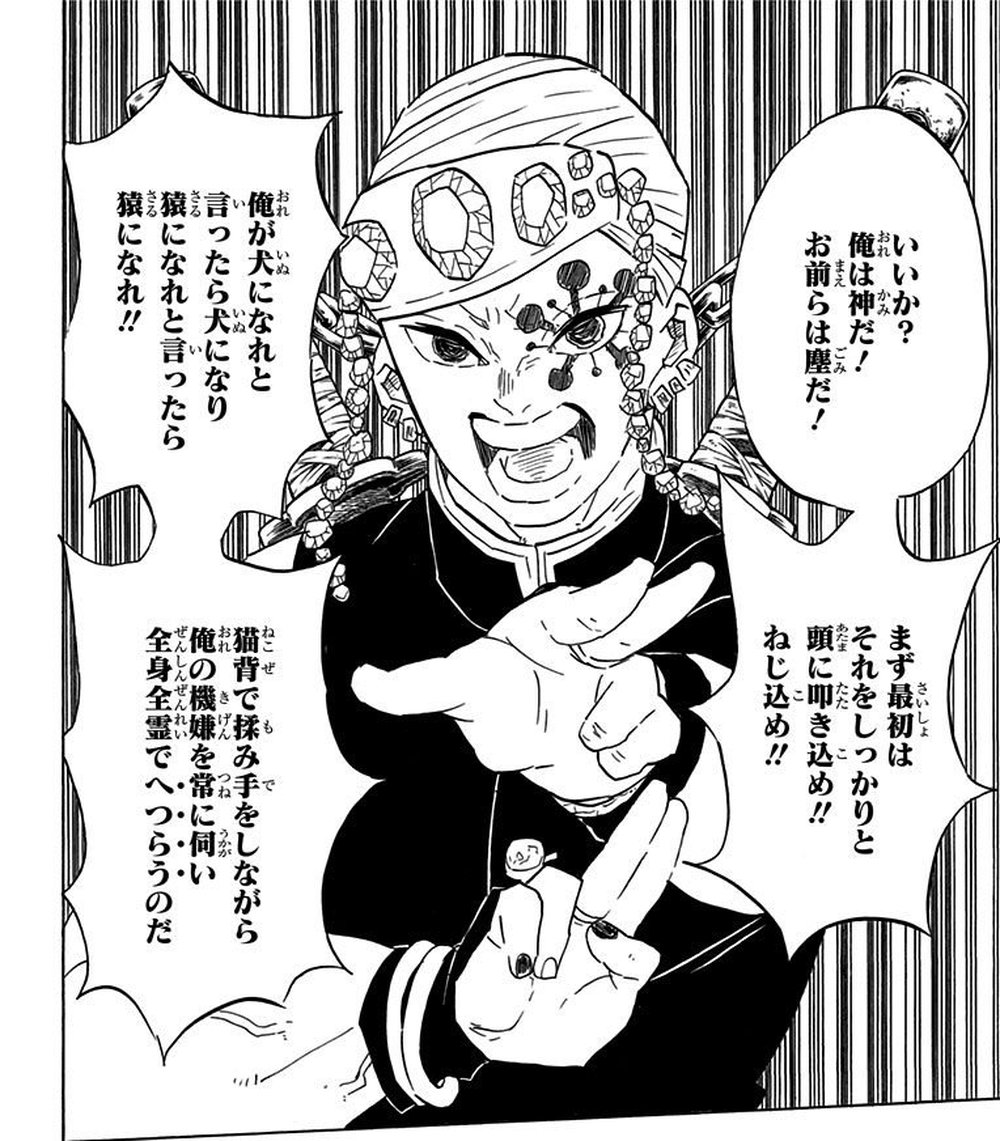
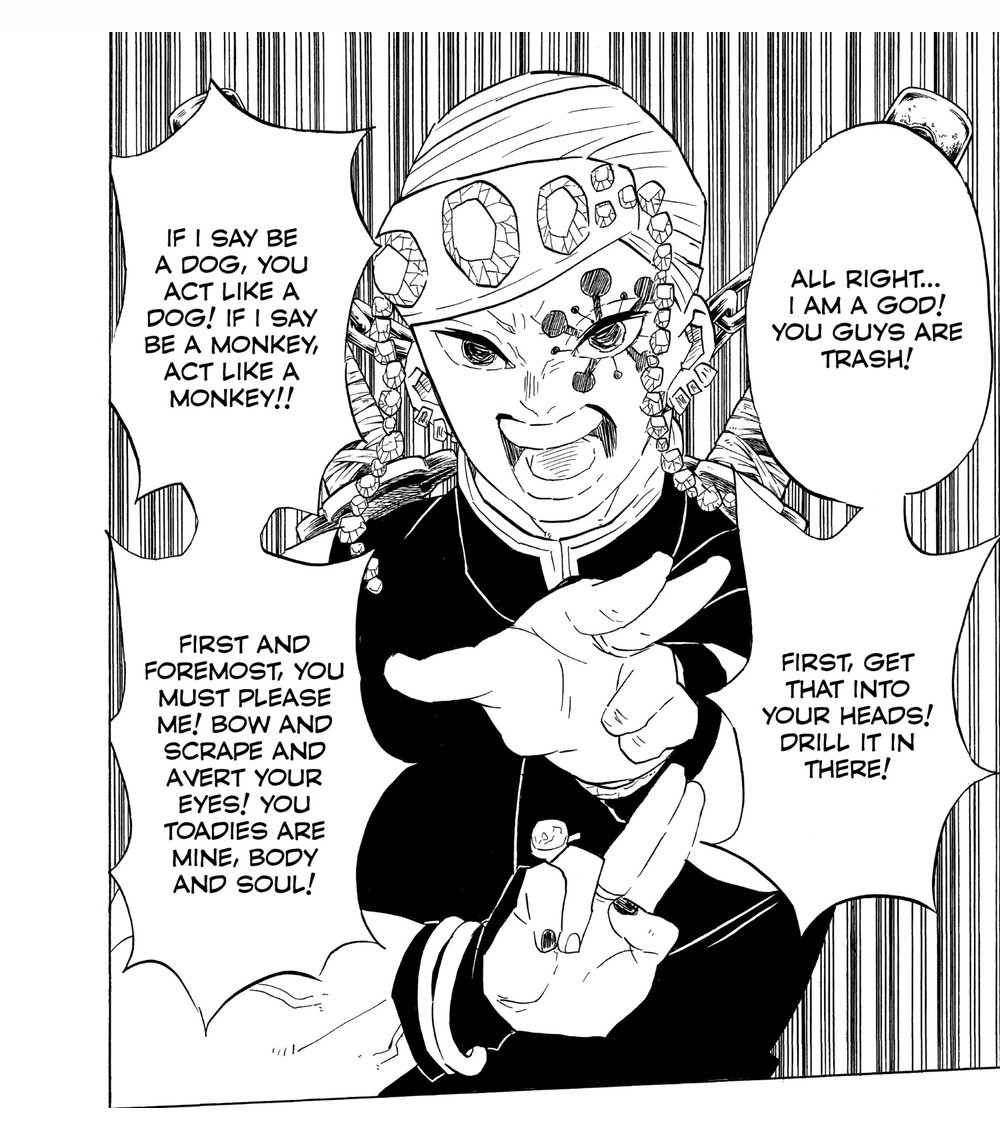
Volume 9 opens a new arc — the Entertainment District — with an entrance built entirely out of ego. Tanjiro, Zenitsu, and Inosuke are standing outside a walled estate when a man in a bejeweled headdress vaults onto the top of the wall, strikes a pose, and starts issuing decrees. He isn't introducing himself as a Hashira. He's introducing himself as a deity:
「いいか?俺は神だ!お前らは塵だ!!」
Ii ka? Ore wa kami da! Omaera wa gomi da!!
"ALL RIGHT... I AM A GOD! YOU GUYS ARE TRASH!"
He lays out the terms of worship in three more bursts — obey like a dog or a monkey on command, drill it into your heads — and then delivers the line this article is about, addressed to the three strangers he has just met:
「猫背で揉み手をしながら俺の機嫌を常に伺い…全身全霊でへつらうのだ。」
Nekoze de momite o shinagara ore no kigen o tsune ni ukagai… zenshin-zenrei de hetsurau no da.
VIZ's English edition prints: "FIRST AND FOREMOST, YOU MUST PLEASE ME! BOW AND SCRAPE AND AVERT YOUR EYES! YOU TOADIES ARE MINE, BODY AND SOUL!" (Vol. 9, p.8).
Grant the rendering its due, because this is a genuinely well-built line. "Bow and scrape" nails 猫背で揉み手をしながら (hunched back, hand-rubbing — the stock body language of a fawning shopkeeper) in two idiomatic words instead of a literal clause. And "BODY AND SOUL" is not a compromise or a paraphrase — it's the real English cousin of 全身全霊, arrived at instead of invented. The catch, as always in this column, is in the details the match doesn't quite carry over.
The Original
全身全霊 (zenshin-zenrei) is two ordinary two-character nouns fused by a shared intensifier. Start with 全身 (zenshin): 全 (zen), "entire, whole," plus 身 (shin), "body." This half is common vocabulary — you'll meet it at the hospital in 全身麻酔 (zenshin masui, "general anesthesia") or at the gym in 全身運動 (zenshin undō, "full-body exercise"). Now the second half: 全 doubles onto 霊 (rei), "spirit, soul" — the same 霊 sitting inside 幽霊 (yūrei, "ghost") and 霊魂 (reikon, "soul") — to give 全霊 (zenrei), "the whole spirit." Unlike 全身, 全霊 almost never stands alone; it exists to be paired.
That pairing is the point. 全身全霊 is a yojijukugo built on reduplication: the same qualifier, 全, planted twice, once in front of a physical noun and once in front of a spiritual one, so the compound covers both halves of a person in one gesture. It is structurally identical to compounds like 誠心誠意 (seishin-seii, "with utmost sincerity," 誠 doubled) or 正々堂々 (seisei-dōdō, "fair and square," 正 and 堂 each doubled) — see our companion articles on those words for the same pattern at work. Grammatically, で marks 全身全霊 as an adverb: 全身全霊で = "with [my] whole body and soul," modifying whatever verb follows — here, へつらう, "to fawn, flatter, toady," closed out with the blunt declarative のだ.
VIZ's Choice
This is the only appearance of 全身全霊 in the Kimetsu no Yaiba volumes on file, so there's no scatter-table to build — but the single data point is worth sitting with, because it runs against the grain of almost every other article in this series. Usually the finding here is loss: English has no word, or five different words, for one Japanese concept. This time English already owns the concept. "Body and soul" is a genuinely old, genuinely fixed English idiom, and it splits along exactly the same seam as 全身全霊 — one physical noun, one spiritual noun, joined by "and." A translator hunting for an equivalent could not have done much better.
But watch what VIZ does with the match once it has it. The Japanese sentence structure is [underling's actions] + 全身全霊で + へつらうのだ — the totality modifies the verb of fawning. VIZ restructures the whole bubble into three short commands ending in a noun clause: "YOU TOADIES ARE MINE, BODY AND SOUL!" Here "body and soul" no longer modifies an act of flattery; it modifies a claim of possession, "ARE MINE." The idiom is real, but its job in the sentence has been swapped — from adverb of effort to complement of ownership.
The Gap
The totality changes owners. In Japanese, the person doing all the giving is the underling: you will flatter me with your whole body and soul. In VIZ's English, the totality belongs to Tengen: you — body and soul — are mine. Both readings are still funny and still menacing, and a case can be made that "you toadies are mine, body and soul" is punchier on the page. But it is a different sentence, grammatically, from the one printed above it — one where the subordinate's exertion has quietly become the god's possession.
The cliché doesn't survive the border. 全身全霊で頑張ります is worn smooth from overuse in Japanese job interviews, sports interviews, and political speeches — it is the "110 percent" of Japanese self-presentation, and career-advice columns actively warn candidates against leaning on it because everyone does. Tengen's joke is a parody of that specific, recognizable script: he's making strangers recite a fresh-hire's loyalty pledge to him. "Body and soul" is idiomatic in English too, but its cliché lineage runs through torch songs and love letters ("I'm yours, body and soul"), not job interviews — so a joke survives, but not quite the same joke.
The reduplicated pattern goes dark. 全身全霊's 全…全… structure visibly rhymes with 誠心誠意 and 正々堂々 to any reader who has met a few yojijukugo — it announces itself as a member of a family of compounds. "Body and soul" reaches the same two nouns through the accident of English idiom history, not through a repeatable grammatical rule, so nothing about the English phrase signals kinship with its Japanese siblings once it crosses over.
What If
- "YOU SHALL FLATTER ME, BODY AND SOUL!" — keeps VIZ's real idiom match but reattaches it to the verb, exactly where the Japanese puts it. Cost: loses the punchy noun "TOADIES" and the escalation into a possession claim.
- "WITH EVERYTHING YOU'VE GOT — GROVEL!" — keeps the totality and the barked, imperative energy. Cost: "everything you've got" is a generic effort-idiom; the specific body/soul doubling vanishes.
- "HEART AND SOUL, YOU'LL FAWN ON ME!" — the closest single-swap match in English's devotion vocabulary, keeping the reduplicated feel. Cost: "heart" trades out the physical half (身, body) for an emotional one.
- "YOU'RE MINE — EVERY LAST INCH, EVERY LAST BREATH!" — an ownership line like VIZ's, but built from scratch to keep a two-part physical/spiritual anatomy rather than borrowing the fixed idiom. Cost: wordier, and "breath" is a stretch for 霊.
Take-away
全身全霊 is the rare word in this column that has a real English answer waiting for it — "body and soul" splits the same physical/spiritual seam the Japanese does. What still gets lost isn't the vocabulary; it's the architecture around it: which party the totality belongs to, which cliché is being mocked, and whether the phrase visibly belongs to a family of matched compounds.
Three rules of thumb to carry off this page:
- A good idiom match can still be regrammared. Finding the right words doesn't guarantee they land in the right slot of the sentence — check what the totality is modifying, not just what it names.
- 全…全…, 誠…誠…, 正…正… — watch for the doubled qualifier. It's a productive yojijukugo pattern, not a one-off; once you can spot it, 全身全霊 unlocks its whole family of cousins.
- A cliché is only a joke if the reader recognizes the cliché. Tengen's line only lands as parody if you know what a sincere 全身全霊で頑張ります sounds like — the humor rides on Japanese workplace ritual as much as on the words themselves.
This word joins a small cluster of Kimetsu no Yaiba yojijukugo this site has tracked one panel at a time: Kokushibo's 一刀両断, one stroke ending an argument outright; Tanjiro's 縦横無尽, covering every direction at once; Akaza's 正々堂々, a dying demon's highest compliment, doubled exactly the way 全身全霊 is; Tamayo's 自暴自棄, turning self-abandonment into a Mencius idiom; and Hantengu's 極悪非道, a demon's own verdict on himself. Browse the full Demon Slayer translation notes index for more.
Every Japanese and English line quoted above is a byte-exact capture from the cited editions — 鬼滅の刃 Vol. 9 (Japanese) and Demon Slayer: Kimetsu no Yaiba Vol. 9 (VIZ Media) at the corresponding panel — via our bilingual page database; see Sources below.