The Moment
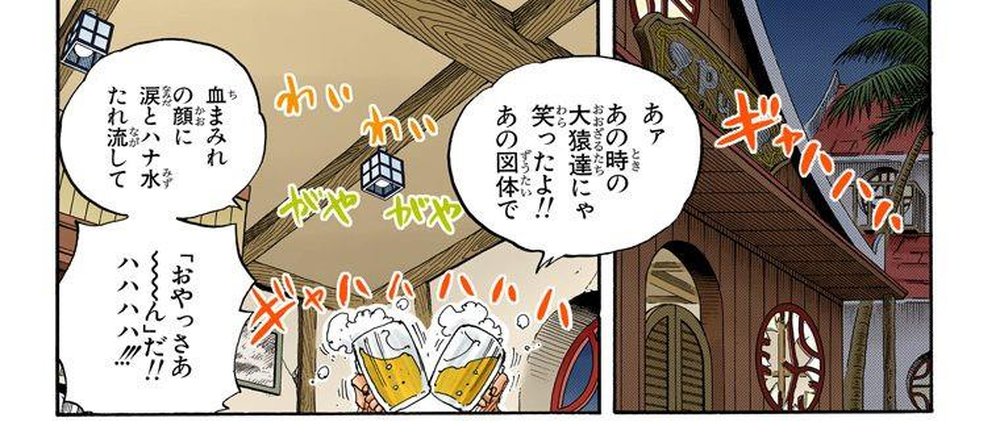
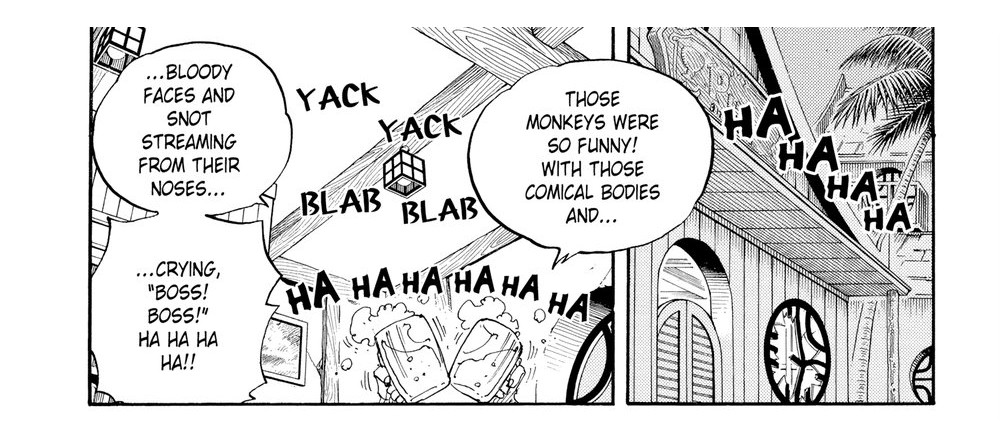
Mock Town, the lawless bounty-hunter settlement on the island of Jaya. Night. A knot of Bellamy's crew are a few rounds deep, mugs already clashing together mid-toast. The bar has spent the whole day finding things to laugh at — a few panels earlier, this same table got a laugh out of a set of "weaklings" who'd dared say out loud that they wanted to reach a Sky Island (unknowingly, the joke was on Luffy's own crew). The memory they're toasting to now is older still: a rival gang, thrashed for getting between Bellamy's men and whoever they call "boss."
「あァあの時の大猿達にゃ笑ったよ!!あの図体で」
Aa, ano toki no ōzaru-tachi nya waratta yo!! Ano zūtai de…
VIZ's English edition prints: "THOSE MONKEYS WERE SO FUNNY! WITH THOSE COMICAL BODIES AND..." (Vol. 25, p.112).
Grant the rendering its due first: it's a clean, punchy setup, it keeps the drunken bragging energy, and "SO FUNNY" earns the laugh the panel is going for. But sit next to the word actually doing the work — 図体 (zūtai) — and something has quietly changed shape. VIZ's "comical" describes how those bodies LOOKED. 図体 describes what they were WORTH: nothing, for all their size.
The sentence keeps going, into the next bubble, completing the joke:
「血まみれの顔に涙とハナ水たれ流して「おやっさあ~~ん」だ!!バハハハ!!!」
"...BLOODY FACES AND SNOT STREAMING FROM THEIR NOSES... ...CRYING, 'BOSS! BOSS!' HA HA HA HA!!"
A few bubbles later, another voice at the table fills in who was worth defending, and why the beating happened at all:
「そんなに大事ならしっかり守ってやれってんだハハハ!!」
"IF HE WAS SO PRECIOUS TO THEM, THEY SHOULD'VE PROTECTED HIM BETTER. HA HA HA HA!"
— followed, a beat later, by the name that makes clear whose table this is:
「フフ...そう言ってやるなよ相手がお前やベラミーじゃしょうがねェ」
"HEH HEH... WHAT COULD THEY DO AGAINST YOU AND BELLAMY?"
Put the pieces together: a crew loyal to the bounty hunter Bellamy, reminiscing about flattening a rival gang — almost certainly the ape-costumed Saruyama Alliance, shipwrights loyal to the treasure hunter Montblanc Cricket, whom Bellamy's men have spent this entire arc humiliating for chasing a dream they've decided is childish. The "big monkeys'" size was the one thing that might have made them dangerous. 図体 is the word chosen to say it wasn't.
The Original
図体 (zūtai) looks, at a glance, like a compound built from meaning: 図 (zu, "a drawn figure, diagram" — the same 図 in 地図, chizu, "map") plus 体 (tai, "body"). Read that way, it's "the shape a body draws" — a poetic-enough gloss plenty of native speakers would offer if asked.
But word-origin dictionaries trace the pronunciation differently, and the real story is stranger. zūtai is generally explained as a worn-down descendant of 胴体 (dōtai, "torso, trunk") — the same 胴 in 胴上げ (dōage, tossing someone in celebration) or 胴回り (dōmawari, waist measurement). Somewhere along the way, dōtai slid in speech toward zūtai, and once the sound had drifted far enough from the original spelling, someone reached for 図 purely because it can be read zu — ateji, a kanji chosen for its sound and nothing else, the same trick behind 目出度い (medetai, "auspicious") or 兎に角 (tonikaku, "anyway"). 図 has no more to do with "diagram" here than the "ough" in "though" has to do with anything.
Whichever etymology you find more convincing, usage settled the word into one narrow lane. Dictionaries gloss 図体 flatly as body size, most often used to belittle a large body. It isn't the word you'd use for a body you respect — that's 体格 (taikaku), the coach's word, or 身体 (shintai), the clinical one. 図体 is what's left when neither applies: a frame that's big, and nothing else worth mentioning.
The grammar in our headline line does its own quiet work. あの図体で pairs the noun with で, the conjunctive particle that doesn't end a sentence but launches into the next clause — "with THAT zūtai of theirs, [they then did this embarrassing thing]." The size isn't the whole joke; it's the setup, priming exactly how far the coming punch line is about to fall. As vocabulary, 図体 sits around JLPT N1 — not because either kanji is exotic (both are taught by N4) but because the compound's specific derisive collocation is a native intuition no textbook drills.
VIZ's Choice
図体 shows up once in the One Piece volumes we have on file — but it belongs to a small cluster that spans three unrelated shōnen series. Laid side by side, the real test of what English does with this word comes into focus:
| Work / Vol.-p. | Japanese | VIZ English |
|---|---|---|
| Demon Slayer Vol. 13 / p.173 | 親父は図体がでかい上にろくでもなかった | MY FATHER WAS BIG BUT GOOD-FOR-NOTHING. |
| One Piece Vol. 25 / p.107 (JP) · p.112 (EN) | あァあの時の大猿達にゃ笑ったよ!!あの図体で | THOSE MONKEYS WERE SO FUNNY! WITH THOSE COMICAL BODIES AND... |
| Naruto Vol. 14 / p.129 | ったく成長したのはその図体だけかァ!?見ちゃられねーのォ!! | SHEESH! IS THAT HULKING BULK OF YOURS THE ONLY THING THAT'S MATURED?! I COULDN'T JUST KEEP WATCHING! |
Three unrelated series, three different translators' hands, one word, three different escape routes.
Demon Slayer goes plainest: Sanemi's flat "BIG" reports a fact and leans entirely on the following "GOOD-FOR-NOTHING" to do the sneering 図体 was already doing alone. It's accurate and inert — contempt survives, but only because the sentence rebuilds it from a second word.
Naruto is the outlier, and worth noticing precisely because it's rare: "HULKING BULK" is the one rendering in this whole cluster that reaches for an English size-word carrying its OWN built-in judgment, the way 図体 does natively. Two words standing in for one, but the sneer survives the trip.
One Piece takes the strangest path of the three — not toward a neutral fact, and not toward a size-word with contempt built in, but sideways, into a different flavor of mockery entirely. "COMICAL" doesn't judge whether the size was worth anything. It judges how the size LOOKED: funny, absurd, cartoonish. That's a real form of ridicule — but it's ridicule of appearance, not of substance, and 図体's specific charge (you're big, and that bigness turned out to be worth nothing) quietly exits the sentence in the swap.
The Gap
Contempt for wasted size becomes comedy about appearance. あの図体で doesn't ask the reader to laugh at what the "big monkeys" looked like — it sets up a laugh at what their size failed to deliver: no strength that mattered, no threat that held up, nothing behind the bulk. "COMICAL BODIES" asks English readers to laugh at the shape instead. Both panels get a laugh. They are not the same laugh.
The insult moves out of the noun and into the scene around it. In Demon Slayer, "GOOD-FOR-NOTHING" had to import 図体's judgment because the neutral "BIG" couldn't carry it alone. Here, VIZ doesn't reach for a second word to restore that judgment at all — the slapstick imagery one line later (bloodied faces, streaming snot, wailing for "boss") does the mocking instead. The joke survives. The specific word's specific claim — that the size itself was a con — doesn't.
Three works, three solutions, and English readers never see the seam. A reader who only has VIZ's English can't know that "BIG," "COMICAL BODIES," and "HULKING BULK" are the same Japanese noun landing in three unrelated stories. In Japanese, this is a small, recognizable idiom — the kind a fluent reader clocks instantly, the way an English reader clocks "all brawn, no brains." In English, it's invisible three times over, and only Naruto's translator happened to reach for the one word that would have let it show.
What If
For the Mock Town line, the menu and its prices:
- "THOSE APES WERE HILARIOUS! ALL THAT HULKING SIZE FOR NOTHING—" — borrows Naruto's solution, importing built-in contempt via "hulking." Cost: reads closer to a mentor's gruff needling than a pirate sneering at a beaten rival; the register skews a shade too fond for Mock Town.
- "THOSE APES WERE A RIOT! SUCH BIG DUMB BODIES, AND FOR NOTHING—" — spells out the size-plus-uselessness combination the Japanese noun carries in one syllable-pair. Cost: blunter and wordier than 図体's compact, single-noun sneer.
- "THOSE MONKEYS CRACKED ME UP! ALL THAT BULK, AND WHAT DID IT GET THEM—" — turns the trailing で into a rhetorical question, spelling out 図体's "wasted" judgment explicitly. Cost: adds a clause the Japanese doesn't have, slowing the joke's build-up.
- Keep VIZ's own word, restore the sting: "THOSE MONKEYS WERE SO FUNNY! ALL THAT COMICAL BULK, AND FOR NOTHING—" — merges VIZ's comedy with 図体's contempt in one phrase. Cost: "for nothing" still does, in two words, what the Japanese noun does alone in one.
Take-away
図体 isn't a bigger word for "body" — it's a verdict about whether the size was worth anything, wearing a body's clothes. Bellamy's crew reach for it to mock a rival gang whose one apparent asset — being big — turned out to be exactly nothing when it mattered. VIZ's "comical bodies" gets a laugh in the same panel; it just isn't the laugh the Japanese noun was built to deliver.
Three rules of thumb to carry off this page:
- Ask what kind of laugh a "big"-adjacent line is going for. If a translation mocks how something LOOKS, check whether the Japanese was really mocking what it FAILED TO BE. 図体's sneer is about substance, not shape.
- Watch for English size-words that arrive pre-loaded with judgment — hulking, brawny, lumbering — versus ones that only describe appearance — comical, funny-looking, cartoonish. 図体 belongs with the first group; only one translator in this cluster reached for it.
- で at the end of a clause is a setup, not a period. あの図体で doesn't finish a thought — it opens one, priming exactly how far the punch line is about to fall.
This word belongs to a small three-work cluster: Demon Slayer's own line flattens the same noun to "BIG" in Sanemi Shinazugawa's flashback about his father, and Naruto's Jiraiya lands the cluster's one rendering that keeps the sneer intact, needling the T&I officer Ibiki Morino with "HULKING BULK" — no article for either sibling occurrence is live on their own hubs yet, but both panels are quoted above. For another line where VIZ reached for a punch line instead of the register underneath it, see the tombstone pun VIZ built out of 往生しろ. For a word whose English rendering scatters scene to scene the same way 図体 does across three manga, see the karmic tie English splits five ways in 因縁. Or browse the One Piece translation notes index.
Every Japanese and English line quoted above is a byte-exact capture from the cited editions — ONE PIECE Vol. 25 (Japanese) and One Piece (VIZ Media) at the corresponding panels, with single comparison panels from 鬼滅の刃 Vol. 13 and NARUTO―ナルト― Vol. 14 — via our bilingual page database; see Sources below.