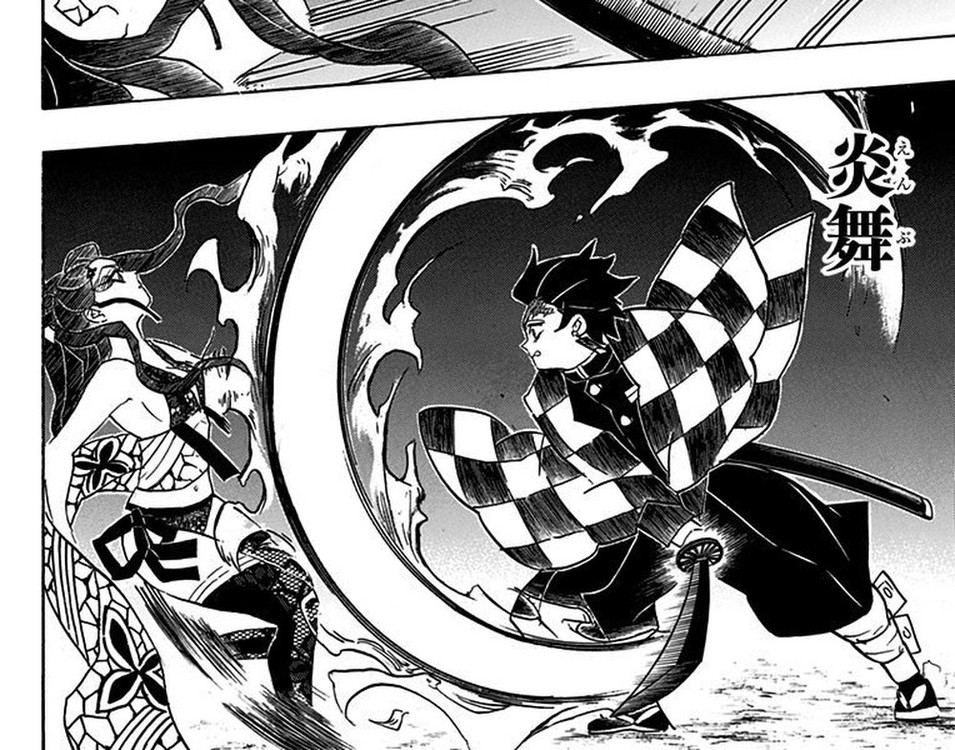
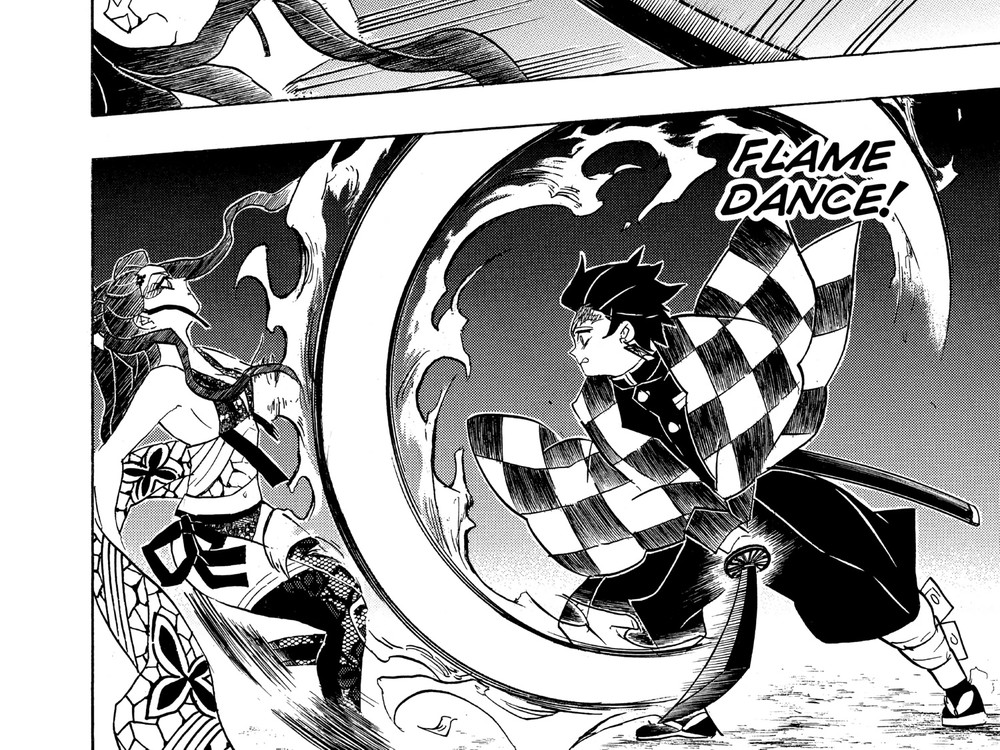
VIZ translates 炎舞 about as literally as a technique name gets — "flame" and "dance" both survive intact as "FLAME DANCE!" — which makes it a useful control case for how un-literal VIZ gets with the rest of the style. Compare it to 斜陽転身 becoming the slightly more interpretive "SETTING SUN TRANSFORMATION!" or 飛輪陽炎 compressing into "SOLAR HEAT HAZE!": Enbu is the one dance in this dictionary where the English reader gets exactly the same two nouns, in exactly the same order, as the Japanese reader. That plainness is doing real work, though — HINOKAMI KAGURA itself stays untranslated and romanized on every page it appears (see Vol. 9 p.146, Vol. 17 p.114, Vol. 18 p.28), while the individual dance names underneath it are always rendered into English. Flame Dance is the cleanest illustration of that split: the umbrella term is treated as a proper noun VIZ won't touch, but the moves inside it are treated as ordinary vocabulary VIZ is happy to translate outright.
The more interesting story is the one the manga itself points out: 炎舞 is a homophone of 円舞 ("Enbu," Circling Dance), a completely different dance built from different kanji. Volume 22's climactic flashback has Tanjiro notice this directly — "〝円舞〟と〝炎舞〟/同じ音の技名" ("'Round Dance' and 'Flame Dance'... technique names with the same sound," Vol. 22 p.96) — and the observation isn't idle trivia, it's the key to unlocking the previously-unknown thirteenth form. According to that same sequence, Tanjiro reasons that the twelve inherited dances form a repeating ring precisely because "十二の型は円舞と炎舞で全て繋がる" — the twelve forms are all linked together by Circling Dance and Flame Dance acting as connective tissue between the others. It's a rare case of a shonen manga building an actual etymological pun into its power-system logic: two dances that sound identical in speech but are written with unrelated kanji turn out to be the structural seams holding the whole technique circle together.
One sourcing note: this stretch of Volume 22 runs one page ahead in VIZ's English pagination relative to the Japanese edition (the same kind of offset that affects parts of Vol. 19), so the underlying bilingual corpus's automated pairing for the p.96 panel above pairs the correct Japanese line with an English caption from the wrong panel. The quote used in this entry's occurrences was verified directly against the real VIZ page image (Vol. 22, p.97) rather than trusted from the corpus's raw alignment.