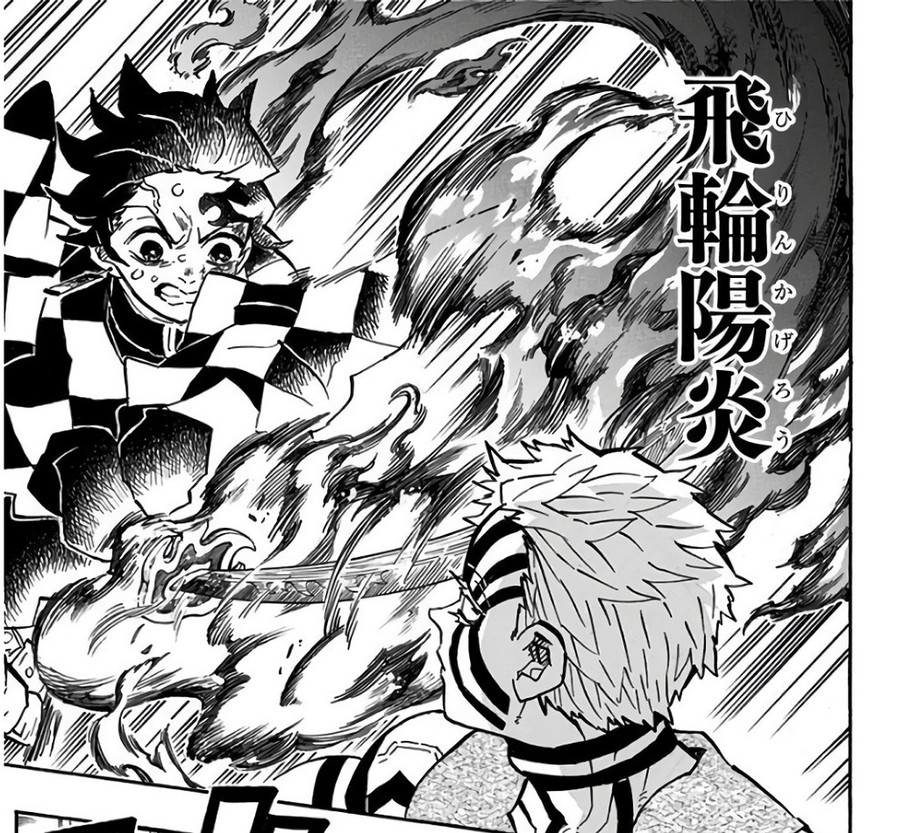
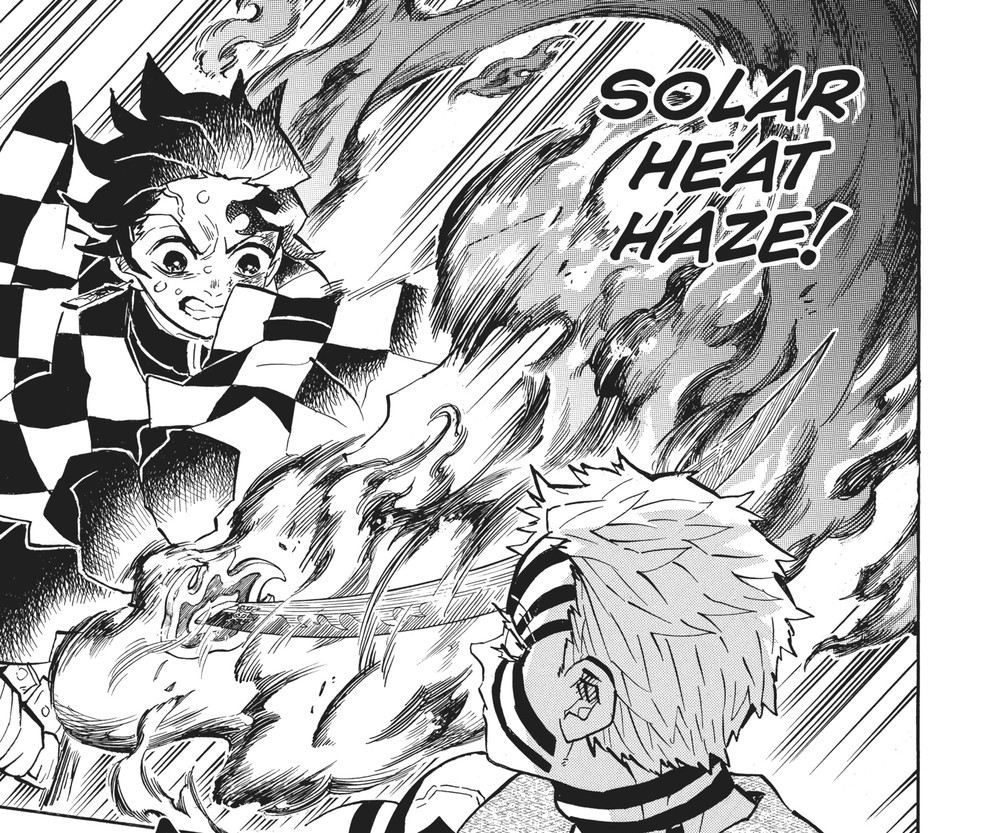
陽炎 (kagerou) is a small showcase of how Japanese compound words don't always add up the way their parts suggest. Read kanji-by-kanji, 陽 is "sun" and 炎 is "flame," so a literal-minded guess at 陽炎 would land on something like "sun-flame" — which is basically what Akaza, the demon on the receiving end of this technique, might reasonably assume from the name alone. But 陽炎 is a fixed compound with its own dedicated reading (kagerou) and its own dedicated meaning that has nothing to do with fire: it's the ordinary, common word for heat haze, the shimmering distortion you see above hot asphalt in summer. VIZ's translator clearly knew this — "SOLAR HEAT HAZE!" gets the real meaning exactly right rather than falling into the sun-flame trap — but the choice does mean English readers lose the pun that a Japanese reader gets for free: this is a Sun Breathing technique whose name looks like it should mean "flame" and actually means "shimmer," a small bait-and-switch baked into kanji orthography itself, invisible once translated into an alphabet that can't carry a silent misreading the way kanji can.
The compound has a second layer worth mentioning even though it's mostly decorative folklore rather than active wordplay in this context: written identically, 陽炎 is also the classical Japanese word for a mayfly (kagerou), an insect whose one-day adult lifespan made it a stock image in classical poetry for fleeting, insubstantial beauty — the same association English poetry gets from butterflies or morning dew. That's almost certainly coincidental to how Gotouge chose the word here (陽炎 the weather phenomenon is by far the dominant modern meaning), but it's a nice accidental resonance for a technique that's fundamentally about visual deception: a strike that isn't really where it looks like it is, named after both a shimmer that isn't really there and, homophonically, an insect whose whole existence is a kind of fleeting shimmer itself. 飛輪, the other half of the name, is comparatively plain by contrast — "flying wheel" is exactly what it says, the one purely mechanical, non-poetic image in an otherwise loaded four-kanji name.