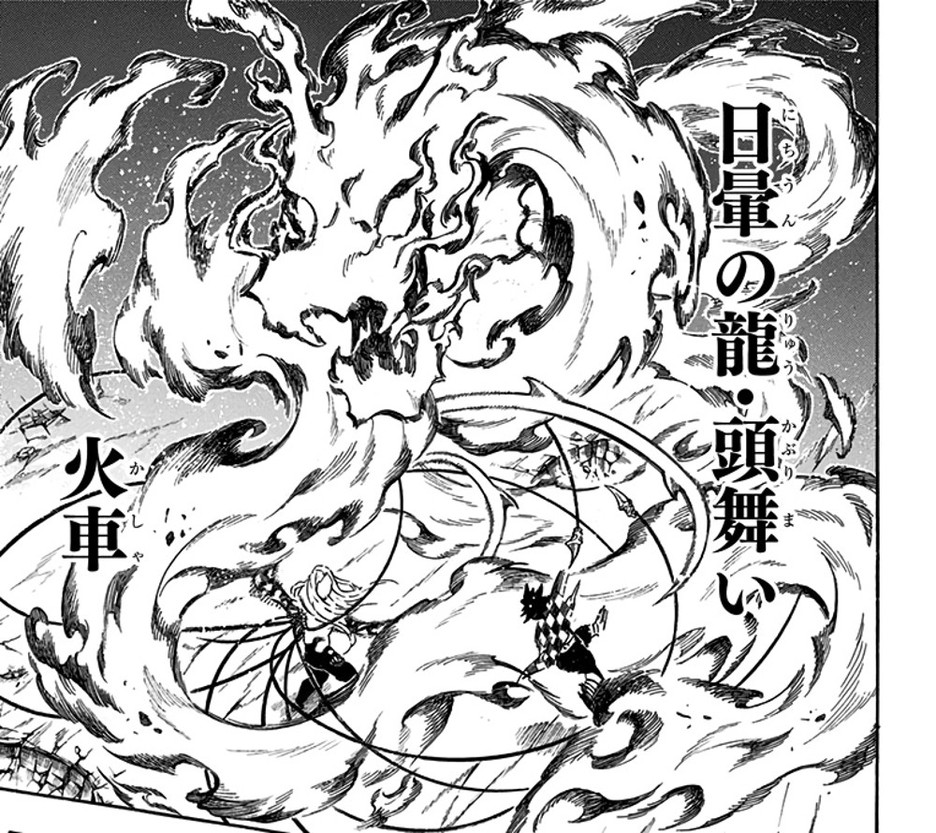
This entry required a direct correction to the working romanization brief it started from, and it's worth stating plainly since it's the kind of detail an English-language dictionary can easily get wrong by extrapolating from the character 頭 alone: the manga's own furigana, printed directly above the kanji in the Vol. 22 splash where all twelve forms are listed together, reads 頭舞い as かぶりまい (kaburimai), not かしらまい (kashiramai). 頭 has several legitimate readings — あたま and とう are the common ones, かしら shows up in words like 頭領 ("leader") — but かぶり specifically ties back to 被る, "to be covered by" or "to wear over the head," which fits a dragon-shaped attack that arcs up and over the target rather than a dance that is merely "about" a head. Gotouge appears to be using an intentionally unusual reading here, the way many named techniques across shonen manga borrow a rare or irregular gloss for a common kanji specifically because a familiar word read strangely sounds more like an incantation than an ordinary noun phrase.
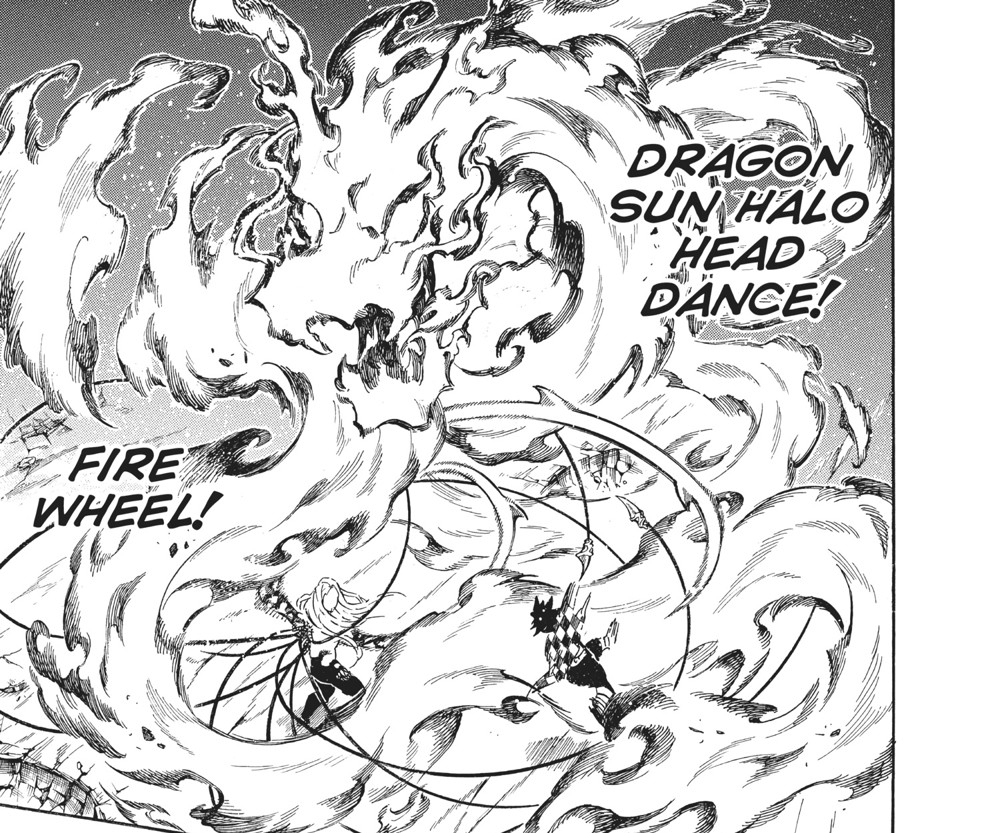
On the translation side, this is the longest fully-rendered dance name in the style on this hub — four English words, "DRAGON SUN HALO HEAD DANCE," where most of its siblings compress to two or three ("RAGING SUN," "CLEAR BLUE SKY"). That length tracks the density of the Japanese: 日暈の龍・頭舞い is genuinely two stacked images joined by a visible nakaguro (・) — "the dragon of the solar halo" and "the head dance" are punctuated as two linked but separate ideas in the original typography, and VIZ's translation preserves that compound structure rather than collapsing it into a single shorter phrase the way it does elsewhere in the style. The corpus's Vol. 22 citation for this dance also sits inside one of this hub's known VIZ pagination-offset zones: the Japanese-edition page showing '日暈の龍・頭舞い' corresponds not to the identically-numbered English page but to the English page one number ahead, confirmed by direct visual inspection of both printed pages — the corpus database itself records no English pairing for that specific Japanese panel, which this entry's occurrence list corrects using the verified adjacent-page English text rather than leaving the field blank or guessing.
Story-wise, this dance's every corpus appearance comes paired immediately with 火車 ("Fire Wheel") — the two are drawn as a single continuous coiling motion across consecutive panels, dragon and burning wheel merging into one attack, both in the Vol. 22 Muzan duel and its Vol. 23 continuation. That pairing is consistent enough across the corpus that it reads less like coincidence and more like a deliberate two-form combo within the twelve-dance sequence, the same way 円舞 reliably opens a chain and 烈日紅鏡 reliably follows a setup strike elsewhere in this style.