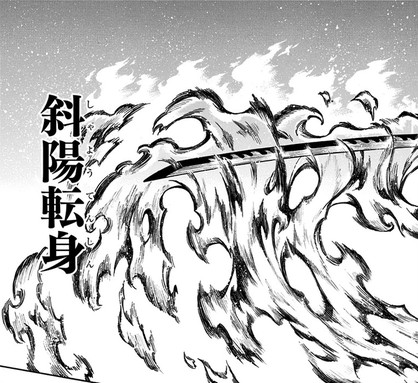
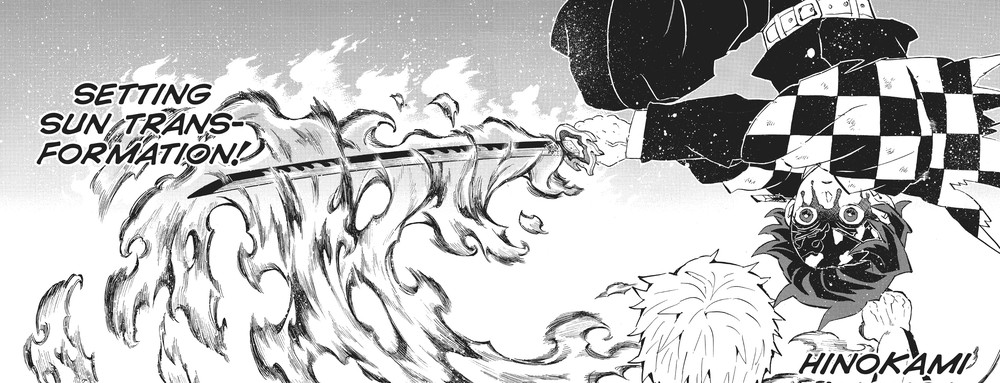
斜陽 is a word with more literary baggage than its plain dictionary gloss suggests. It's the title of Dazai Osamu's 1947 novel 斜陽 (translated into English as The Setting Sun), a story about a declining aristocratic family in postwar Japan, and the word carries a faint connotation of graceful decline — not just "the sun is setting" but "something once-great is fading, beautifully." It's a strange, almost melancholy word to build a combat technique around, and VIZ's "SETTING SUN TRANSFORMATION!" doesn't (and probably can't, in four words shouted mid-battle) carry that literary undertone into English — an English reader gets an accurate, functional translation of the astronomy, but not the small cultural echo a Japanese reader gets from a word that's equally at home in a poem about a fading noble house as it is in a sword technique.
The 転身 half of the name is doing more literal work than the fancy 斜陽 half: 転身 isn't really "transformation" in the shapeshifting sense English readers might assume from the callout (Hinokami Kagura doesn't do that) — it's closer to "pivot" or "reorientation," the body turning on its axis the way the sun itself appears to swing low and pivot toward the horizon at dusk. VIZ's choice of "transformation" is a reasonable but slightly inflated translation of a word that in everyday Japanese just as often describes a career change or a personal reinvention (転身する, "to reinvent oneself") as it does anything physical. That makes 斜陽転身 the rare Hinokami Kagura name that's simultaneously about a literal body movement and, if you squint at the word choices, about impermanence and turning points — appropriate for a technique that shows up twice in this dictionary's corpus at two of the most pivotal turning points in Tanjiro's story: the Hantengu fight that pushes him toward becoming a Hashira-caliber swordsman, and the final dawn battle against Muzan where the sun itself — the thing 斜陽 describes — finally becomes the weapon that ends the series' war.