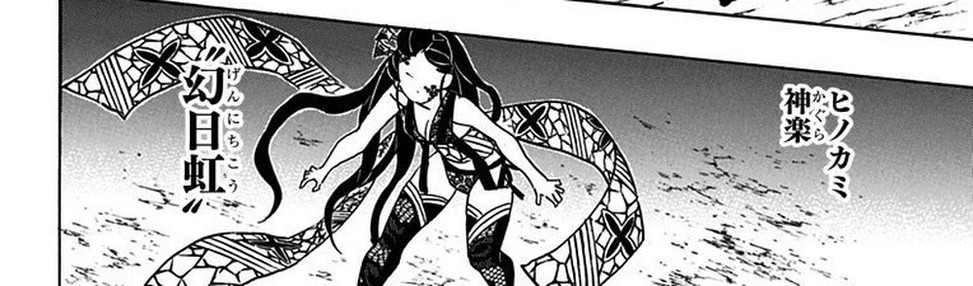
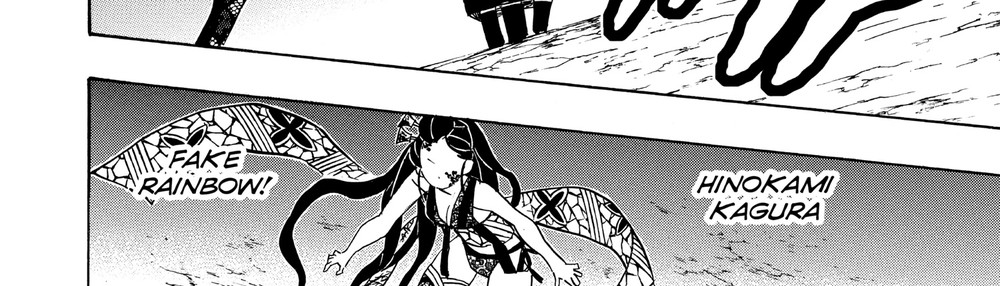
This is the deepest translation-and-etymology rabbit hole in the whole Hinokami Kagura set, because 幻日 is not a word Gotouge invented — it's real meteorological vocabulary. A 幻日 (usually read genjitsu) is what English calls a "sun dog" or parhelion: a bright, rainbow-tinged spot of light that appears beside the sun when sunlight refracts through hexagonal ice crystals suspended in high, cold cirrus clouds, producing what looks like a second, ghostly sun hanging in the sky. That's precisely the conceptual joke buried in this dance's design: 幻日虹 is a Sun Breathing technique — a style literally themed around light and the sun — whose signature move is a fast spin that makes Tanjiro's afterimage into a kind of manufactured optical illusion, a fake secondary image thrown off by a source of light and motion instead of ice and sunlight. The corpus's own in-panel gloss makes the mechanism explicit: "高速の捻りと回転による躱し特化の舞/視覚の優れた者ほど/よりくっきりとその残像を捉えてしまう" — a dodge-specialized dance built from high-speed twisting and spinning, where the sharper an opponent's eyesight is, the more clearly they end up perceiving the false afterimage (Vol. 9, p.146). A real atmospheric halo deceives the eye with light bent by ice; Tanjiro's Fake Rainbow deceives the eye with a body bent by speed. Worth flagging: this manga corpus's own OCR renders the furigana reading as げんにちこう (gennichikou), using the nichi reading of 日 rather than the jitsu reading real-world meteorologists use for 幻日 (genjitsu) — a small but genuine divergence between the in-story dance name and the everyday weather term it's built from.
VIZ's handling of the name is inconsistent in a way that's worth documenting rather than smoothing over. In its clearest appearance (Vol. 9, fighting Daki) the callout reads simply "FAKE RAINBOW!" — dropping the "phantom sun" half of the compound entirely and keeping only the rainbow. But earlier, in Vol. 17 (fighting Akaza), the same two opening kanji 幻日 appear alone at a page-turn cliffhanger and are rendered instead as "MOCK SUN" — a completely different English gloss for the same characters, presumably because that panel is cut off before 虹 appears and the translator had only "phantom sun" to work with, not the full compound. Read together, the two renderings actually reconstruct the joke better than either alone: a mock/phantom sun (幻日) that throws off a fake rainbow (虹) is exactly the sun-dog phenomenon this dance is named after, split across two different fights, three volumes apart, by two different translation choices for the same word.