This is the one dance name in Hinokami Kagura that Koyoharu Gotouge didn't have to invent, because it already existed — as folklore, not fiction. In Japanese Buddhist tradition, 火車 (kasha) is a burning demon cart, sometimes described as cat-shaped or accompanied by cat-like yokai, that arrives at funerals to seize the corpses of the wicked and drag them off to hell before a proper burial can be completed. The image comes from Buddhist hell-cosmology more broadly: sinners in some hell realms are transported by burning carts as part of their punishment, and 火車 is the folk personification of that mechanism made mobile — a vehicle of post-mortem retribution that shows up specifically for people who lived badly. Regional legends embellish it further: a kasha might slip into a wake through a storm, snatch the body from the coffin mid-funeral, and vanish, leaving mourners with an empty casket as proof that the deceased's sins outweighed any last rites performed for them.
Placing that name inside Sun Breathing — the style most explicitly coded as protective, ancestral, and benevolent in the entire series, taught to Tanjiro by his own father as a New Year's ritual — is a genuinely pointed choice, not a coincidence of naming convenience. A demon slayer's blade, in the story's own moral logic, exists to end demons who have chosen to keep devouring people rather than die as humans; several of the demons Tanjiro faces are explicitly framed as having earned their fate through cruelty they chose and re-chose. Naming the technique that finishes such an opponent after a folk creature whose entire job is hauling the irredeemable off to punishment isn't incidental flavor — it reframes the strike itself as something closer to a sentence being carried out than an act of anger. The visual design backs this reading up directly: 火車's corpus appearances (Vol. 9 against the spider family's "Mother," and Vol. 22 against Muzan himself) both draw the attack as a literal wheel of fire, sword-strikes tracing a spinning burning disc around the target exactly the way the yokai's iconography depicts its wheel-cart silhouette.
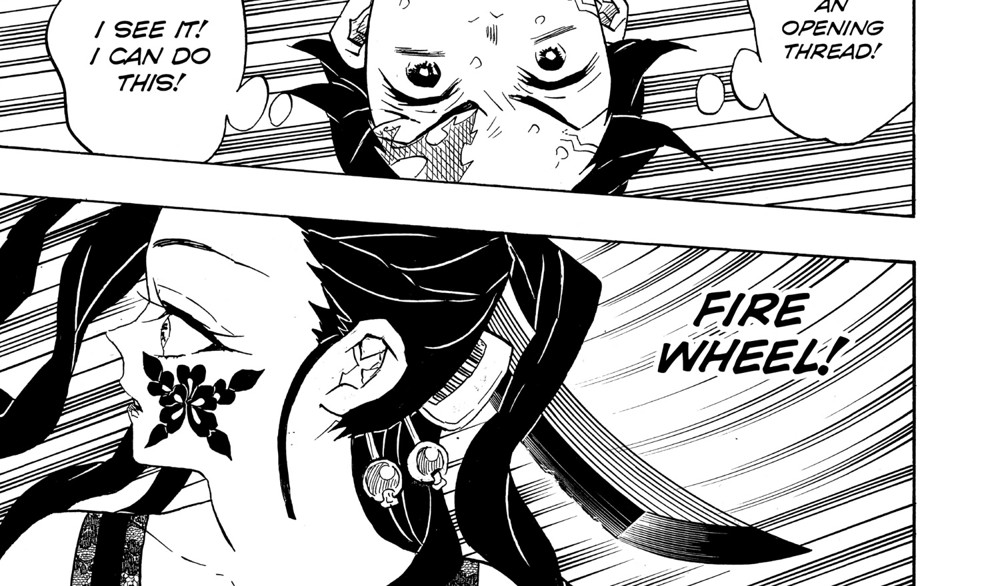
VIZ's "FIRE WHEEL!" is accurate but necessarily loses the folklore entirely — an English reader with no exposure to Japanese Buddhist funerary folklore has no way to recover "corpse-snatching hell-cart" from two plain nouns, and there's arguably no two-word English phrase that could carry it. That's a real, unrecoverable translation gap rather than a stylistic compression like some of this hub's other Hinokami Kagura entries: "RAGING SUN" still evokes fierce heat even with 紅鏡 dropped, but "FIRE WHEEL" evokes nothing about damnation, karma, or funeral rites at all. The Japanese title carries a genre — this is a name borrowed from horror and hell-imagery — that the English title simply doesn't signal, which is worth knowing if you've only ever encountered this technique through the VIZ translation or the anime's English dub.
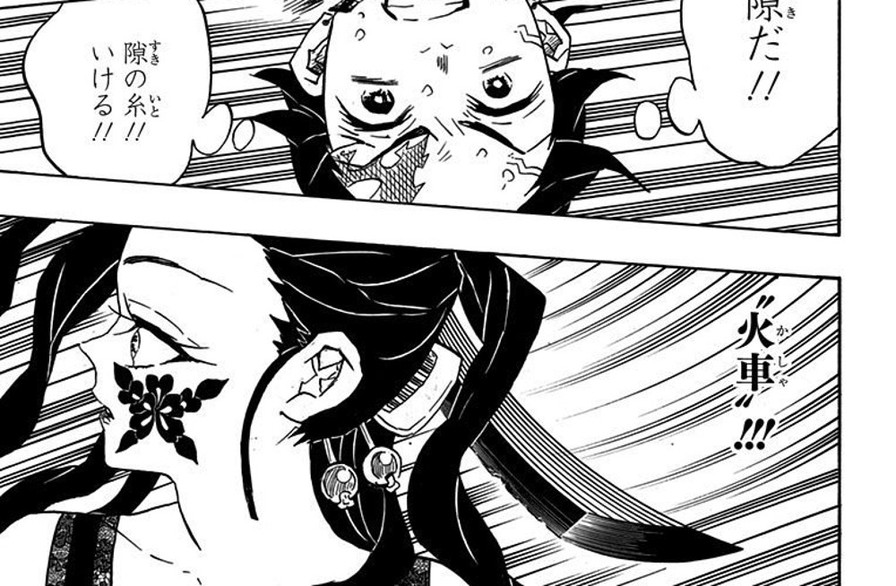
The corpus's Vol. 9 citation is also worth a second look on its own terms: the fight is against the unnamed "Mother" of Rui's spider-thread family, drawn with elaborate traditional hair ornaments and thread-based attacks (the preceding panel's callout literally reads '隙の糸' — "opening thread"), and Tanjiro's 火車 lands as the finishing blow after he spots a gap in her defense. That a technique named for a corpse-collecting hell-cart delivers the finishing strike against a demon who has spent the arc keeping human victims trapped and consumed is, whether by design or resonance, thematically exact.