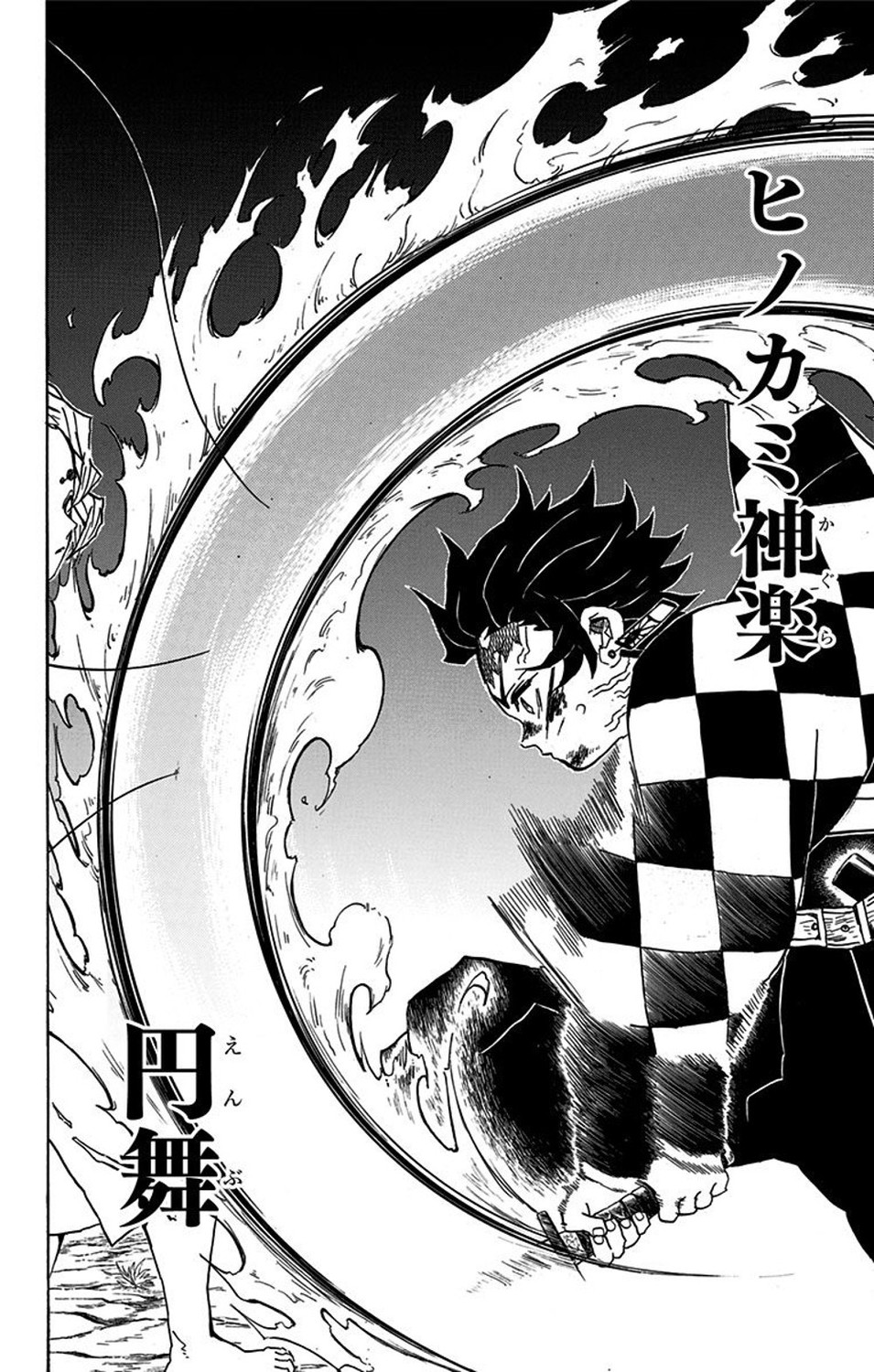
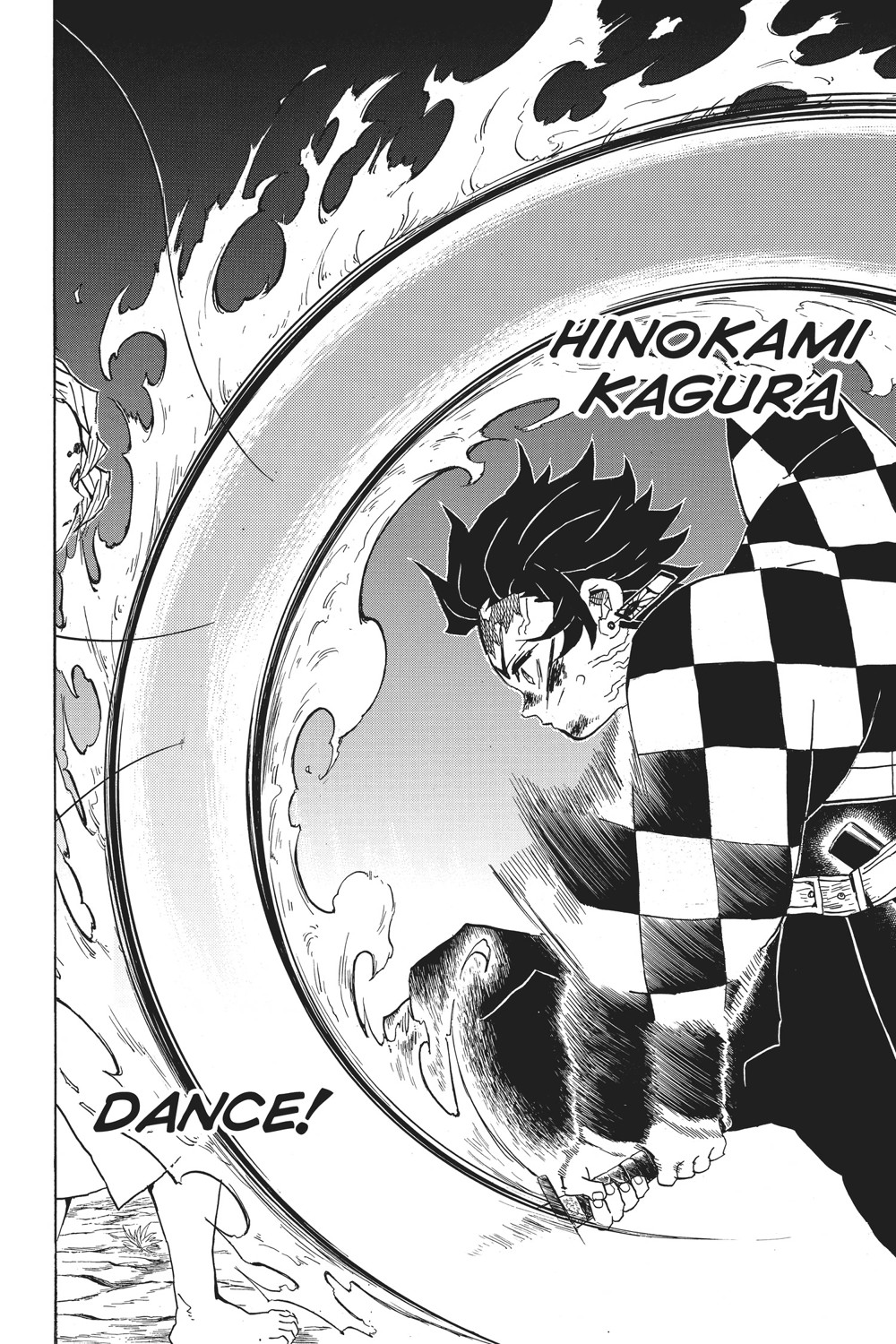
This is the single clearest data point for how VIZ handles this style, and it's worth stating plainly: "HINOKAMI KAGURA" itself stays untranslated and romanized on every page it appears, but the individual dance names underneath it are always rendered into English. Water Breathing's forms keep their geometry ("Water Surface Slash"), Flame Breathing keeps its intensity ("Rengoku" aside), but almost nothing about Sun Breathing's umbrella name survives translation — only its component dances do. 円舞 is the plainest possible illustration of that split: two kanji that mean literally "circle-dance" get boiled down to a single flat imperative, "DANCE!" — no adjective, no elaboration, just the verb. That bluntness is deliberate. As the opening move of a twelve-form sequence that gets progressively more ornate (烈日紅鏡 "RAGING SUN," 幻日虹 "FAKE RAINBOW"), 円舞 needs to read like a starting gesture, not a flourish — the dance equivalent of a first position in ballet.
The corpus's first named appearance of 円舞 (Vol. 5, p.111) carries no paired English text at all — a genuine corpus gap, not a scrambled misalignment. Direct inspection of the corresponding VIZ page confirms this is the single most famous splash panel in Sun Breathing's early run: it's a one-page offset (VIZ page 112, not 111), showing young Tanjiro's first-ever invocation of the dance his father taught him, moments before it saves his life against Rui. The corpus's underlying database simply never captured an English pairing for that specific panel; the real printed line, confirmed by inspecting the actual VIZ page, is "DANCE! HINOKAMI KAGURA."
The most linguistically interesting fact about 円舞, though, doesn't show up until Volume 22, in the middle of Tanjiro's all-night duel with Muzan. Nezuko notices something about the technique names and says it outright: 〝円舞〟と〝炎舞〟 — "円舞 (Enbu)" and "炎舞 (Enbu)" — 同じ音の技名, "technique names with the same sound." 円 (circle) and 炎 (flame) are entirely different kanji with entirely different meanings, but both are read "en," so 円舞 and 炎舞 (the style's twelfth and final form, "Flame Dance") are homophones. The corpus confirms both translations directly: page 097 of Vol. 22 reads '十二の型は円舞と炎舞で全て繋がる' — 'THE TWELVE FORMS ARE ALL CONNECTED BY "DANCE" AND "FLAME DANCE."' Gotouge is using the pun to argue, in-story, that the twelve forms loop back on themselves — the dance that opens the sequence and the dance that closes it are aurally the same word, forming a circle (円) in sound the way the choreography forms a circle in space. That's a piece of wordplay VIZ's translation can't preserve ("Dance" and "Flame Dance" don't rhyme), which is itself a small, honest illustration of what gets lost when a homophone-driven naming scheme crosses into English.