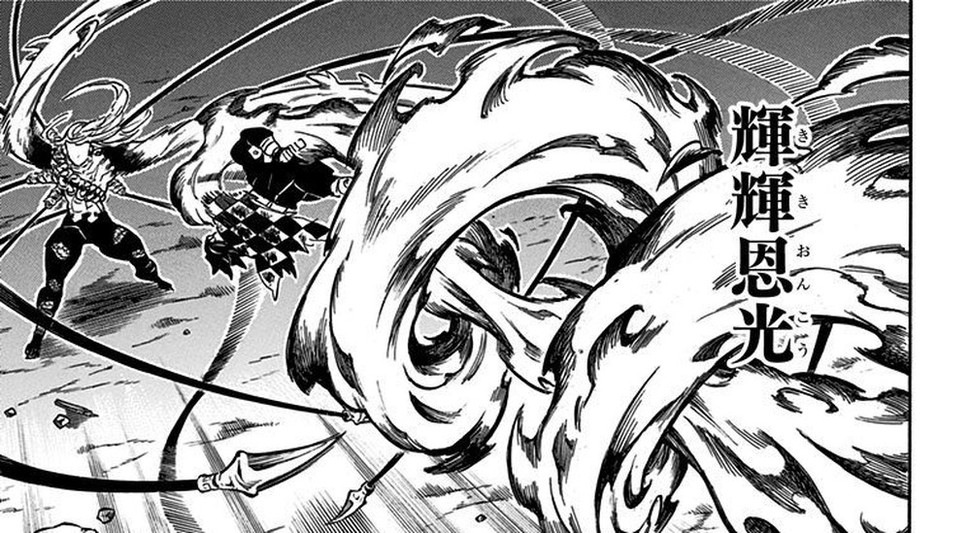
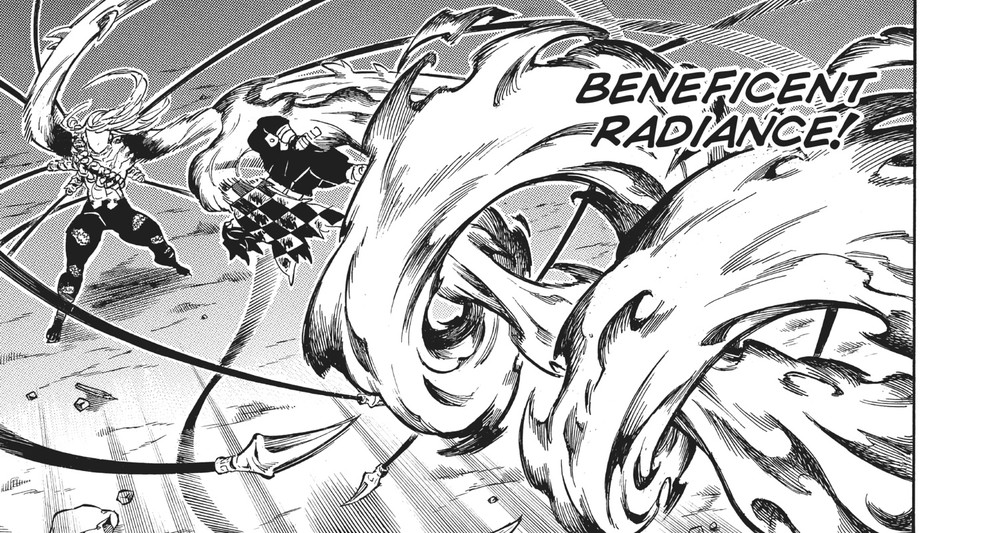
輝輝恩光 is the wordiest, most deliberately ornamental name in this set of twelve dances, and that excess is the point. Doubling 輝 into 輝輝 is a classical Japanese intensifying trick — the same pattern behind everyday words like 人々 (hitobito, "people, one after another") or 山々 (yamayama, "mountain after mountain") — so the name isn't just "shining," it's shining piled on shining, before a second compound (恩光, "gracious light") repeats the shine-imagery yet again with different characters. Four kanji, three separate ways of saying "light," is a lot of redundancy for a technique name, and VIZ's "BENEFICENT RADIANCE!" actually compresses that excess rather than reproducing it — an English reader gets one adjective and one noun, not the layered, almost incantatory repetition a Japanese reader gets. That's a defensible translation call (English doesn't have a natural equivalent to kanji reduplication that doesn't sound clumsy read aloud in a fight scene) but it does mean the English version quietly loses some of the ceremonial, ritual-chant quality that the doubled 輝輝 is going for — appropriate, since Hinokami Kagura is literally a kagura (神楽), a Shinto ritual dance, not just a sword style with a fancy name.
The corpus context for this dance's clearest appearance is worth sitting with: it's deployed during the final battle against Muzan, in the stretch where Tanjiro and the surviving Hashira are grinding through Muzan's endless regeneration until sunrise. The panel immediately preceding Kikionkou notes the toll the fight is taking on Muzan himself — his shockwave attacks are slowing, his arm and tentacle strikes need recovery time between uses — which recontextualizes "beneficent light" from pure aesthetics into something closer to grim irony: a technique named for gracious, benevolent radiance, thrown at the final antagonist of the series as dawn (and the sunlight that kills demons outright) approaches. Every other named dance in this set describes a shape or a motion — a flame, a wheel, a haze, a transformation. Kikionkou is one of the only ones that describes a feeling, and it's not a coincidence that the feeling it evokes lands hardest exactly when the sun Muzan has spent a thousand years avoiding is finally, literally, about to rise.