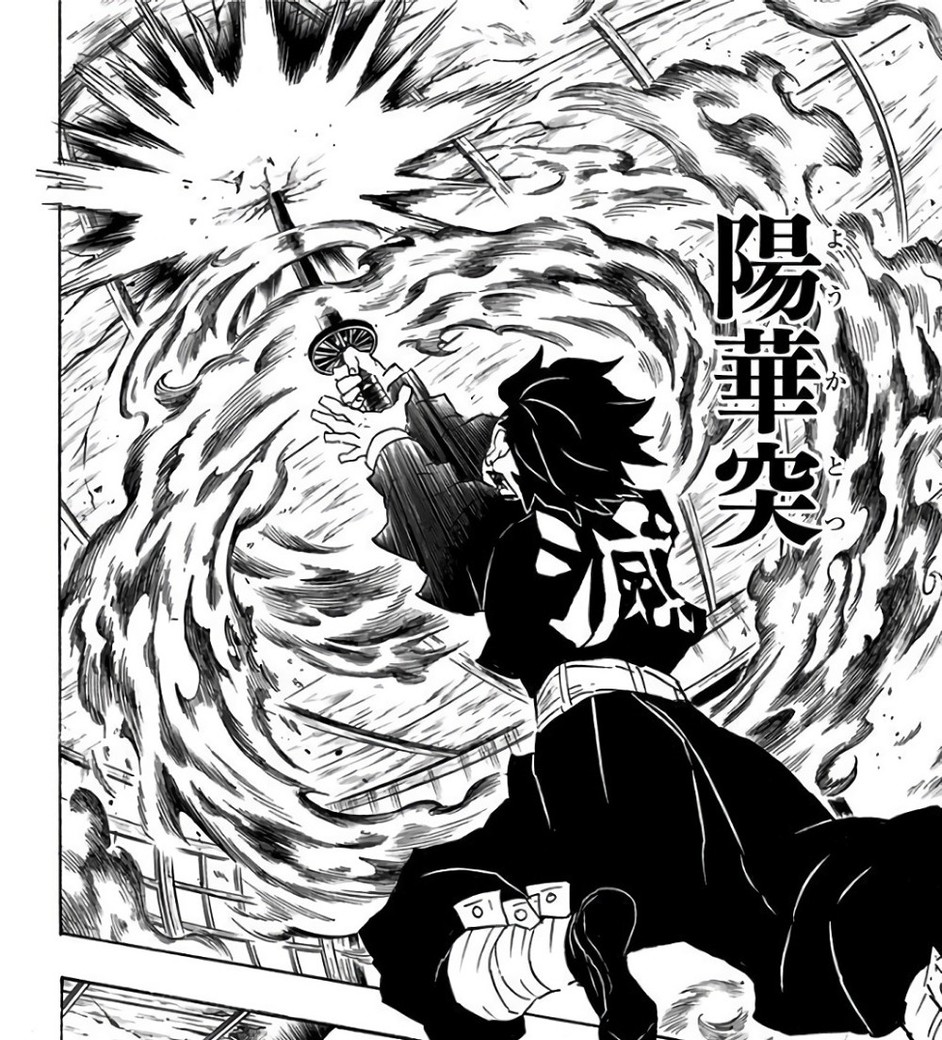
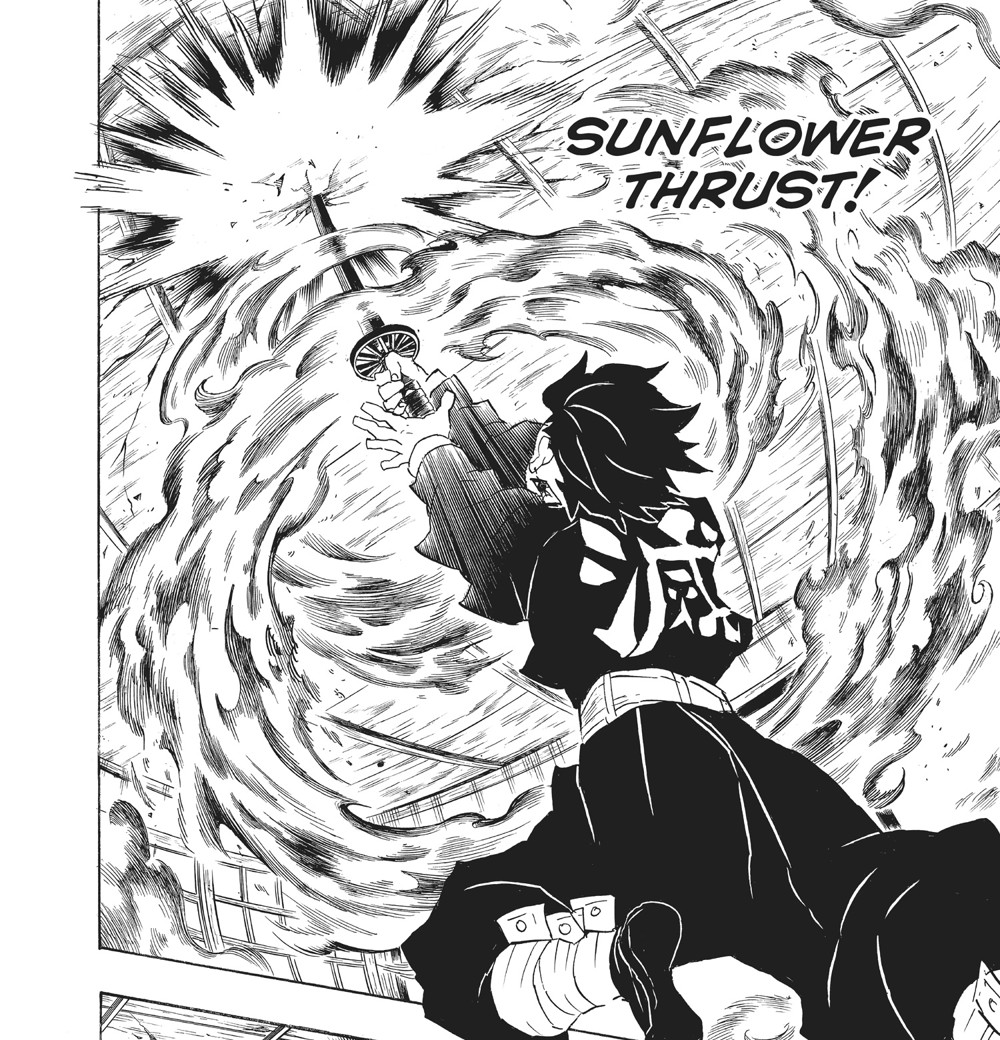
陽華突's translation history is unusually visible in the underlying corpus, because both of its manga appearances required an OCR correction flag before the real kanji surfaced. The automated recognition first read the technique as '勿華やまさか、' on one page and '陽茉莉...' on another — neither of which means anything in context — before a corrected_jp annotation restored the actual printed text: 陽華突. That's a useful reminder for a hub built on corpus citation: dramatic, high-contrast SFX-style lettering (the kind used for a killing blow) is disproportionately likely to defeat OCR, even when the panel art itself is perfectly legible to a human eye. Once corrected, the name is straightforward: "sun-flower thrust," and VIZ's "SUNFLOWER THRUST!" is about as close to a literal, word-for-word rendering as this dictionary sees anywhere in Hinokami Kagura — no compression, no dropped half, no added embellishment.
What makes 陽華突 worth a second look is where the flower imagery comes from. 華 doesn't describe the sky (as in 碧羅の天) or the target's body (as in 灼骨炎陽) — it describes the shape of the attack itself: a single point-blank thrust that, in both its Vol. 12 and Vol. 16 panels, is drawn with a burst of radiating linework around the sword's tip, visually reading as a flower opening outward from the point of impact. That's a rarer move in this style's naming logic, where most dance names describe cause (the sun, the mirror) rather than the resulting visual effect. Its Vol. 16 appearance is also the cleanest example on this hub of the two-tier callout structure that recurs across Hinokami Kagura panels: the style name "HINOKAMI KAGURA" fires first in its own word balloon, immediately followed by the specific dance name in a second balloon — a one-two structure that visually reinforces the VIZ translation convention this whole style runs on, style name left in Japanese, dance name translated, printed one after another on the same page.