The Moment
Syrup Village, East Blue. Captain Kuro has spent three years undercover as the butler "Klahadore," waiting to murder his own mistress Kaya and vanish with her fortune — and today is raid day. His subordinate crew, led by the hypnotist lieutenant "Captain" Django, has been sent ahead through the woods toward the village. Then a runner interrupts with electrifying news: Django's men have found treasure — real treasure, 4 or 5 million berries of it — aboard "that suspicious ship" beached nearby (Usopp's boat, seeded there as bait in the village boy's ongoing scheme to keep the pirates away). Django's greed swallows his orders whole. Mid dramatic flourish — ばーん! ("TA-DA!") — he strikes a pose and makes his own crew an offer:
「その宝に免じてここはひとつ!!!引き返してください!!!」
Sono takara ni menjite koko wa hitotsu!!! Hikikaeshite kudasai!!! — "I'll give you that treasure, if you leave immediately!!"
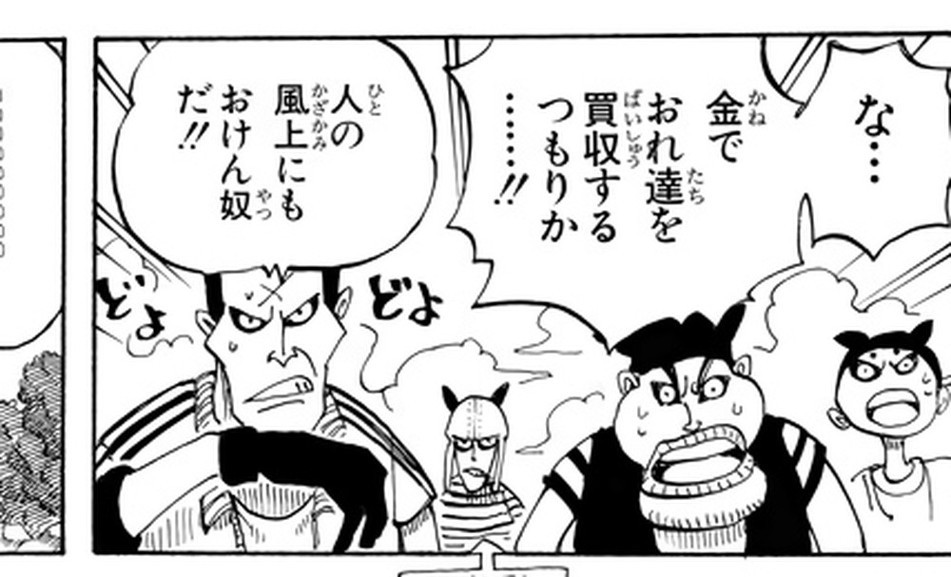
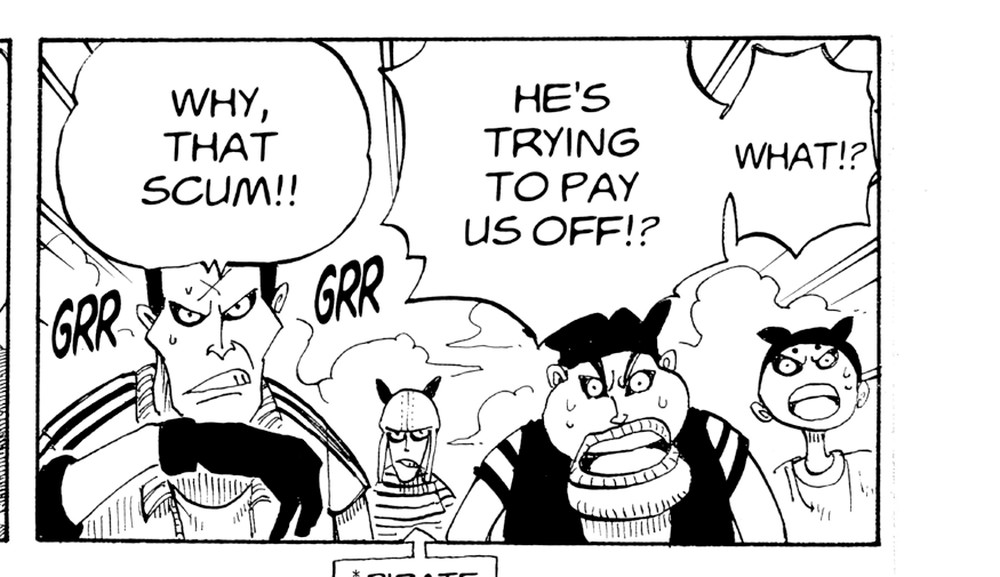
His men do not take this as generosity. Shock curdles into disgust in three quick beats — "YOU'RE GOING TO GIVE US THE TREASURE!?", "HE'S TRYING TO PAY US OFF!?" — and then one pirate, sweat beading, rounds on his own captain:
「人の風上にもおけん奴だ!!」
Hito no kazakami ni mo oken yatsu da!!
VIZ's English edition prints: "WHY, THAT SCUM!!" (Vol. 4, p.53).
Grant the rendering its due first: it's fast, it's punchy, and "scum" is exactly the register a furious pirate would reach for mid-panel — no argument that the crew is disgusted. But listen to what the Japanese actually accuses Django of. Not simply being bad. Being unfit to occupy a specific position in the wind.
The Original
風上 (kazakami) splits into 風 (kaze, rendaku'd to kaza- in compounds) — "wind" — and 上 (kami) — "upper, up-direction." Together: "the upwind side, windward," the exact mirror of 風下 (kazashimo, "downwind, leeward," 下 = shimo, "lower"). おけん is a rough, clipped negative of 置ける, the potential form of 置く (oku, "to put, to place"). Standard Japanese would write 置けない; the abrupt ん-negation — 見られん, わからん, and here おけん — is blunt and masculine, the grammatical equivalent of biting off the end of a sentence instead of finishing it politely.
Put the pieces together and [Xの]風上にも置けない reads, with total literalism: "cannot even be placed upwind of X." The logic behind it is not metaphorical guesswork — it's a straight transfer from pre-modern sanitation. Foul-smelling things (night soil, tanneries, garbage, carrion) were kept downwind of where people lived, so their stench blew away rather than over the household. Put something smelly upwind instead, and its odor travels straight down onto everyone below, whether they want it or not. 風上にも置けない takes that entirely physical fact and repurposes it as a verdict on character: a person can be so morally rank that you cannot tolerate placing them upwind of a given group, full stop — because their "stench" (their shameful conduct) would inevitably blow down and disgrace everyone standing downwind of them, i.e., everyone in that group, by nothing more than proximity.
That's why the construction never appears bare — it always names its group. The dictionary head-entry form is 男の風上にも置けない, "[not fit to stand upwind of] men," i.e., "a disgrace to men." Here, aimed at a fellow pirate rather than at manhood specifically, the crew widens 男 (otoko, "men") to 人 (hito, "people, humankind") — Django isn't just unfit to be counted among men; he's unfit to be counted among people, period.
A nice confirmation of just how literal the underlying image is: elsewhere in this hub's corpus, 風上 shows up doing nothing but its plain, non-idiomatic job. In Demon Slayer Vol. 7, chasing a demon down the length of the Mugen Train, Tanjiro sniffs the air and reports, flatly, 「……鬼は風上」 — VIZ's "THE DEMON IS UPWIND!" — a tracker's nose-first fact, no insult attached. Smell travels downwind; Japanese noticed that fact long before it turned the observation into a verdict on someone's character.
As vocabulary, 風上にも置けない is not itself a JLPT-testable idiom — proverbs and 慣用句 (kan'yōku, fixed idiomatic phrases) generally sit outside the N1–N5 vocabulary ladder, filed instead in idiom dictionaries. Its parts are gradable (風上/風下 as directional compounds sit around N2; 置く itself is elementary N5), but functionally this is native-reader idiom territory — the kind absorbed from manga and conversation, not textbooks.
VIZ's Choice
Our corpus holds exactly one clean occurrence of this idiom across the One Piece volumes on file — this Vol. 4 line — so there's no in-series scatter to chart in a table. But the idiom isn't exclusive to Oda's pirates, and a search of our Naruto corpus for the same needles turns up an almost identical line, eight volumes and a different franchise later. In Vol. 17, deep in the arc where Itachi Uchiha and Kisame Hoshigaki hunt Naruto, Jiraiya — cradling a woman Itachi has just placed under a hypnotic saimingan genjutsu, purely to separate Jiraiya from his student — mutters in disgust:
「ナルトからワシを引き離すために女に催眠眼で幻術をかけるたァ……男の風上にもおけねェやり方だのォ」
Naruto kara washi o hikihanasu tame ni onna ni saimingan de genjutsu o kaketa tā… otoko no kazakami ni mo okenē yarikata da nō.
VIZ's Naruto edition prints: "PLACING A SAIMINGAN GENJUTSU ON A WOMAN TO SEPARATE ME FROM NARUTO... WHAT KIND OF COWARD WOULD DO SOMETHING LIKE THAT?" (Vol. 17, p.50). (Our corpus briefly mis-OCR'd the furigana over 風上 as かきかみ instead of the correct かざかみ visible on the printed page — an OCR artifact, not a printing error, corrected here after checking the raw image.)
Line these two scenes up and something telling happens: two completely different Weekly Shōnen Jump translation teams, working years and franchises apart, reach for the same idiom's two completely different English solutions. Django's crew calls their captain "SCUM" for trying to buy them off with money instead of leading an honest raid. Jiraiya calls Itachi's genjutsu trick "a COWARD['s]" method for using a hypnotized bystander instead of a direct confrontation. Both renderings are locally accurate — a bribe really is scummy, hiding behind a hostage really is cowardly — but stack them side by side and neither one carries a trace of wind, smell, or the specific claim that stepping upwind of decent people would let your stench blow down and shame them all. The idiom is doing identical work in both books. English solves it twice, independently, with zero shared vocabulary.
The Gap
The physics disappears. "Scum" and "coward" both judge a person directly — a character trait, stated flat. The Japanese instead stages a small, specific mechanism: place this person anywhere near decent people, even at a wind's length, even upwind rather than in direct contact, and the group downwind gets fouled by the smell alone. That mechanism, not just the contempt, is the content of the idiom.
The defended group vanishes. [Xの]風上にも置けない always names who is being protected from contamination — 人 (all of humankind) here, 男 (all men) in Jiraiya's line. "SCUM" and "COWARD" are free-floating insults with no defended collective attached; the specific claim "you disgrace everyone standing anywhere near you" collapses into generic contempt aimed at no one but the target himself.
"Scum" and "coward" describe two unrelated vices, not one idiom. Read only in English, a learner would have no way to guess that Django's bribery and Itachi's genjutsu trick are being condemned with the identical Japanese phrase. The idiom's whole rhetorical move — reaching for the same set expression regardless of which specific dishonorable act triggered it — is invisible once each occurrence gets its own bespoke English insult.
Pirate-genre texture goes missing. One Piece is a manga about sailors who track wind for a living, insulting each other with wind vocabulary mid-battle. "SCUM!!" keeps the punch but loses the setting-appropriate wordplay — the small joke that even the crew's insults are nautical.
What If
- "Not fit to stand upwind of decent men!!" — keeps the wind image and the explicit directionality intact. Cost: reads like a period-drama subtitle rather than a punchy manga bubble, and loses "SCUM"'s single-syllable snap.
- "A disgrace to every pirate here!!" — keeps the collective-shaming logic ([X の]風上にも置けない = "a disgrace to X") aimed at a group the scene actually cares about. Cost: the wind-and-stench image disappears completely; it reads as generic scolding.
- "You reek of shame — can't even stand near honest men!!" — keeps the smell metaphor explicit without requiring the reader to already know the idiom. Cost: wordy for a single manga balloon, and "reek" imports an odor-word the Japanese doesn't literally use — 風上 names direction, and the smell is implied, not stated.
- Keep VIZ's punch, restore the group: "SCUM — NOT FIT TO STAND NEAR THE REST OF US!!" — at least names the collective the idiom protects. Cost: still no wind, no upwind/downwind geometry — the specific mechanism of the insult stays untranslated regardless.
Take-away
風上にも置けない proves an insult can be a small piece of engineering: name a direction, name a group, and let physics do the shaming. English's insult shelf skips straight to the verdict and never builds the mechanism that earns it.
Three rules of thumb to carry off this page:
- When you meet [Xの]風上にも置けない, find the group X first. The idiom is never really about the target alone — it's a claim that the target's disgrace would contaminate everyone standing near them, and X names exactly who that "everyone" is.
- Remember the idiom is downstream of a literal fact. Bad smells travel with the wind; this expression is Edo-period sanitation logic wearing a moral-judgment costume. If you ever meet 風上 or 風下 used with no idiom attached — tracking scent, reading weather — you're looking at the same physics the insult is built on.
- A repeated idiom across two different franchises isn't a coincidence worth ignoring. When the same fixed Japanese phrase gets two unrelated English solutions in two unrelated manga, that's a signal the idiom has a stable meaning English simply hasn't built a single word for — check whether your own translation choices could at least rhyme with each other, even across projects.
Django's crew keeps good company in this hub's collection of Buddhist- and etiquette-flavored insults Oda's pirates throw at each other: see 外道 (gedō), the Buddhist heretic English turns into "stinking," "brute," and "fiend", 畜生 (chikushō), the six-realms curse word English turns into "&%$!!!!", and 無礼者 (bureimono), the hierarchy word VIZ flattens into plain anger. Browse the full One Piece translation notes index for more.
Every Japanese and English line quoted above is a byte-exact capture from the cited editions — ONE PIECE Vol. 4 (Japanese) and One Piece Vol. 4 (VIZ Media) at the corresponding panel, with two verified cross-work captures from NARUTO―ナルト― Vol. 17 (VIZ Media) and 鬼滅の刃 Vol. 7 / Demon Slayer: Kimetsu no Yaiba Vol. 7 (VIZ Media) — via our bilingual page database; see Sources below.