The Moment
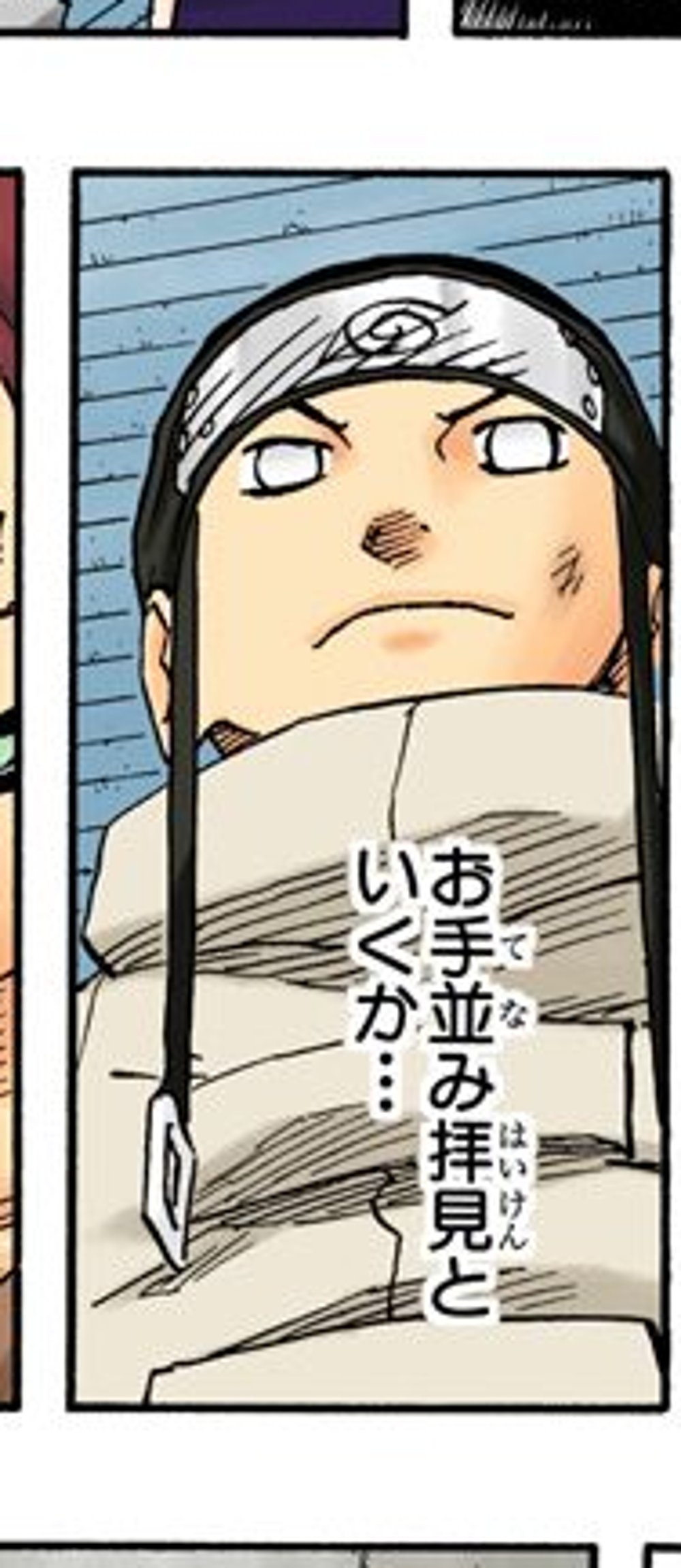
The Chunin Exam prelims, third match: Sasuke Uchiha against Yoroi Akadō, a member of Kabuto's team. The seal on Sasuke's neck — planted by Orochimaru in the Forest of Death — has already started to burn, and the crowd in the stands can feel something is wrong before the fight even turns. Naruto, waiting his turn, bellows across the arena: 「サスケ!...オレと戦いたいんだったら/負けんじゃねーぞ!!」 — "SASUKE! IF YOU PLAN TO FIGHT ME LATER... ...DON'T YOU DARE LOSE NOW!!" A blonde genin murmurs her worry: 「サスケくん...何か様子がおかしい...」 ("THERE'S SOMETHING WRONG WITH SASUKE..."). Rock Lee, fist bandaged and raised, shouts his catchphrase of support: 「サスケくんガンバです!!」 ("GOOD LUCK, SASUKE!!"). And in the middle of that gallery of reactions — sitting beside Gaara's flat silence — one more Leaf genin, headband tight over a high collar that hides the rest of his face, watches with narrowed eyes and says, to no one in particular:
「お手並み拝見といくか...」
Otenami haiken to iku ka…
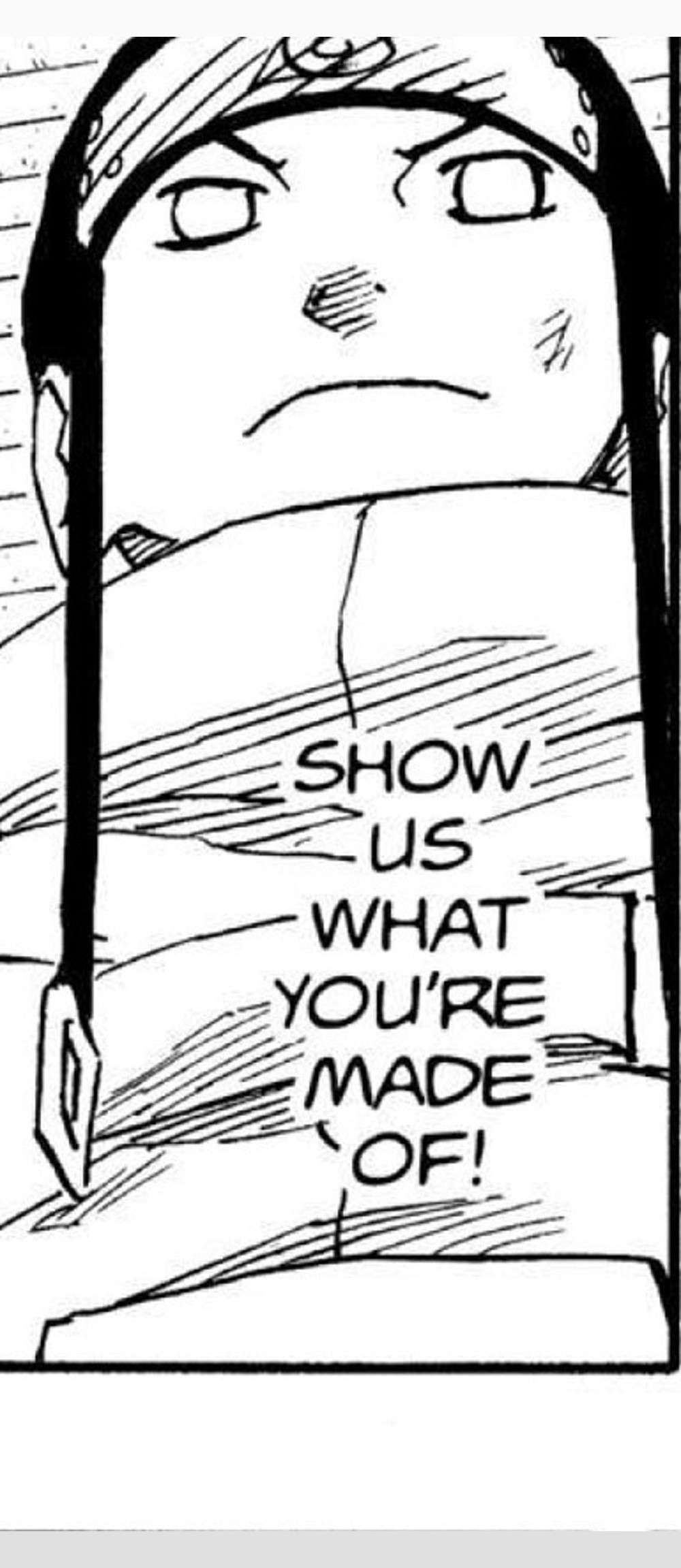
VIZ's English edition prints: "SHOW US WHAT YOU'RE MADE OF!" (Vol. 8, p.69).
Grant the rendering its due: it's a perfectly natural thing for a spectator to think before a fight, it fits neatly into the panel, and "show us what you're made of" carries real challenge — it does not read as friendly. As pure dramatic function, VIZ's line works. What it can't carry over is the specific shape of the challenge: this bystander isn't shouting a dare, the way Naruto is. He's phrasing his skepticism as an act of reverence — and meaning every bit of it ironically.
The Original
拝見 (haiken) is built from two characters worth taking apart slowly, because the first one is doing almost all the work. 拝 (hai) means "to worship; to bow; to press the hands together in reverence." You already know this character from 拝む (ogamu), the everyday verb for praying at a shrine or a grave — palms pressed flat, head bowed — and from 拝啓 (haikei), the stiffly formal "Dear Sir or Madam" that opens a business letter, which literally says "I humbly state." 見 (ken), read the same as in 見る (miru), simply means "to see." Put together, 拝見 does not mean "to look" the way 見る means "to look." It means to worship-see — to direct your eyes at something the way you'd direct them at an altar, performing self-lowering in the very act of looking.
The honorific half of the sentence works the opposite direction. お手並み (o-tenami): 手並み, literally "a lining-up of hands" (手, "hand," plus 並み, "in a row; on par with," the same 並み that gives you 人並み, "average, on par with everyone else"), is an old-fashioned noun for skill, technique, prowess — think of it as "the display your hands can put on." The honorific prefix お- elevates it: not just "skill," but your skill, spoken of with courtesy.
So the four-character phrase お手並み拝見 does two pieces of keigo grammar in one breath: it raises the listener (お手並み, "your esteemed skill") while lowering the speaker (拝見, "this humble one's act of looking"). That's the full architecture of Japanese honorific speech, deployed on a total stranger, mid-crowd, about to watch a genin fight for his life. Then the sentence deflates on purpose: と…いくか, "shall we go with…," is casual, decisive, almost throwaway — the grammar of someone about to crack their knuckles, not someone about to bow. Ceremony, then a shrug. That collision is the whole line.
The Gap
English keeps one register for "see." "Look," "watch," "observe" sit at roughly the same social altitude in English; none of them is manufactured, the way 拝見 is, to perform the speaker's own smallness. There's no single verb sitting in an English dictionary marked "use this one when you want your act of looking to sound like a prayer." A translator reaching for "SHOW US WHAT YOU'RE MADE OF" isn't being careless — English genuinely doesn't stock the part.
The self-lowering is the joke, and a dare can't lower anything. "SHOW US WHAT YOU'RE MADE OF!" is a forward, chest-out challenge — grammatically the opposite posture from the Japanese, which is nominally deferential, almost courtly. The comedy (and the menace) of the Japanese line lives entirely in that gap between humble grammar and mocking intent: a bystander performing reverence he plainly doesn't feel. Once the English line is aggressive on its face, there's no humility left for the sarcasm to undercut — the joke's engine is gone, even though the result, a challenge hanging in the air, survives.
お手並み's half of the courtesy disappears too. "What you're made of" is idiomatic and fits the panel, but it drops the honorific weight VIZ's own "YOUR" implicitly carries in English without the ceremony behind it. The Japanese pays Sasuke's abilities an elaborate, false compliment in the same breath it doubts them; the English just doubts them.
What If
No option here is free — here's the menu and what each one costs.
- "Let's see this... skill of yours." — the pause and "this... skill of yours" gesture at mock-formality without requiring archaic vocabulary. Cost: much softer than 拝見's crisp keigo; reads amused rather than cutting.
- "I shall humbly observe your technique..." — faithful to the dictionary meaning, self-lowering intact. Cost: sounds like a translator's footnote escaped into a speech bubble; no crowd extra in any manga talks like this, in either language.
- "Do go on — impress us." — "do go on" is English's own flavor of sarcastic politeness, the closest functional cousin to sarcastic keigo the language owns. Cost: reads as British costume-drama irony, a register mismatch with a ninja-village bystander.
- "OH, DO SHOW US WHAT YOU'RE MADE OF." — keeps VIZ's punchy dare and grafts on a needling "oh, do" for a whisper of mock-politeness. Cost: nowhere near as compact as お手並み拝見, and 拝's specific worship-imagery is gone regardless of how the sentence is dressed.
Take-away
拝見 is a reminder that keigo isn't only sincere. Japanese built an entire grammar for making yourself small in front of someone else, and the instant that grammar exists, fiction (and real life) can borrow it for the opposite purpose — bowing with the mouth while the face stays flat. English has plenty of sarcasm, but its sarcasm is built from tone and context, not from a dedicated humble verb it can then betray.
Three rules of thumb to carry off this page:
- 拝 always means someone is being lowered — check who. Whether it's 拝見 ("I humbly see"), 拝む ("I worship"), or 拝啓 ("I humbly state"), the character never elevates the speaker. When it shows up sarcastically, that lowering is the entire joke.
- One act of seeing, three Japanese verbs. 見る is neutral, ご覧になる raises the person doing the looking, 拝見する lowers them — the same three-way split (plain / honorific / humble) runs through Japanese's whole verb system, not just "to see."
- Sarcastic keigo needs real keigo to work. The joke only lands if the audience recognizes 拝見 as genuinely, unmistakably humble grammar — the same reason "oh, PLEASE" only stings in English if "please" still means something polite elsewhere.
For the rest of this hub's keigo cluster inside Naruto — the honorific "you" a priest levels at two Akatsuki members in 貴殿 and the officer's "you", the archaic humble "I" a pack of ninja dogs never drops in 拙者 and Pakkun's samurai "I", the copula Kishimoto once gave an alternate Kakashi in ござる and the Kakashi that might have been, and the elder pronoun spoken by a toad, a man, and a fox alike in わし and the elder "I" — or browse the Naruto translation notes index.
Every Japanese and English line quoted above is a byte-exact capture from the cited editions — NARUTO Vol. 8 (Japanese, digital color edition) and Naruto Vol. 8 (VIZ Media) at the corresponding panel — via our bilingual page database; see Sources below.