The Moment
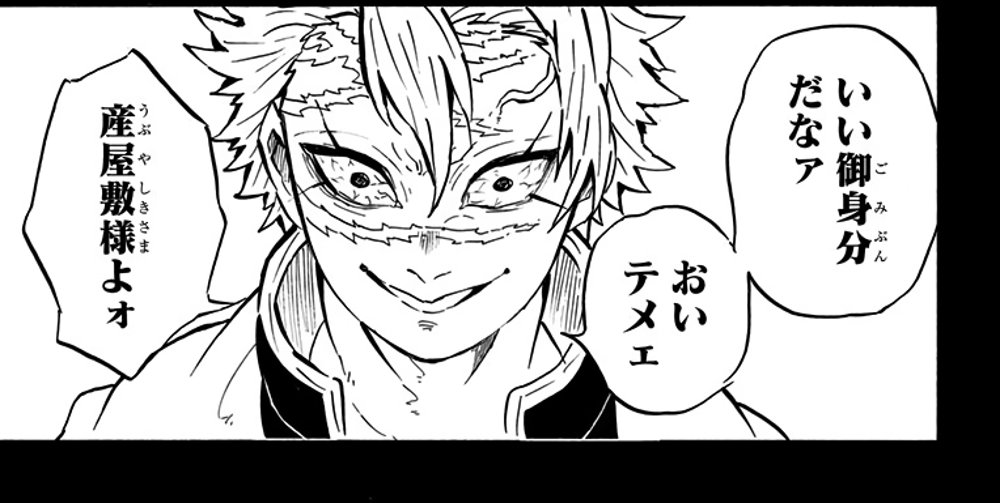
Volume 19. The fight against an Upper Rank demon at the Swordsmith Village has just ended, several Hashira are badly hurt, and the survivors have gathered in Kagaya Ubuyashiki's garden to be received by the man who commands them all. Ubuyashiki kneels calm and untouched on the veranda above, two of his young children beside him. Sanemi Shinazugawa, the Wind Hashira, stares up at that composure and builds an accusation panel by panel: it makes him sick to watch someone smile while others suffer — someone who never dirties his own hands, never risks his own life, who just issues orders from a height with a cool, unbothered face. Then he aims the whole speech at its target:
「いい御身分だなァ」
Ii go-mibun da nā.
Sanemi doesn't stop there. The next bubble is おいテメェ — "hey, you," using てめえ, the roughest second-person pronoun the language owns — and then, worse, 産屋敷様よォ: Ubuyashiki's own name, correctly honored with -sama, spat out like profanity.
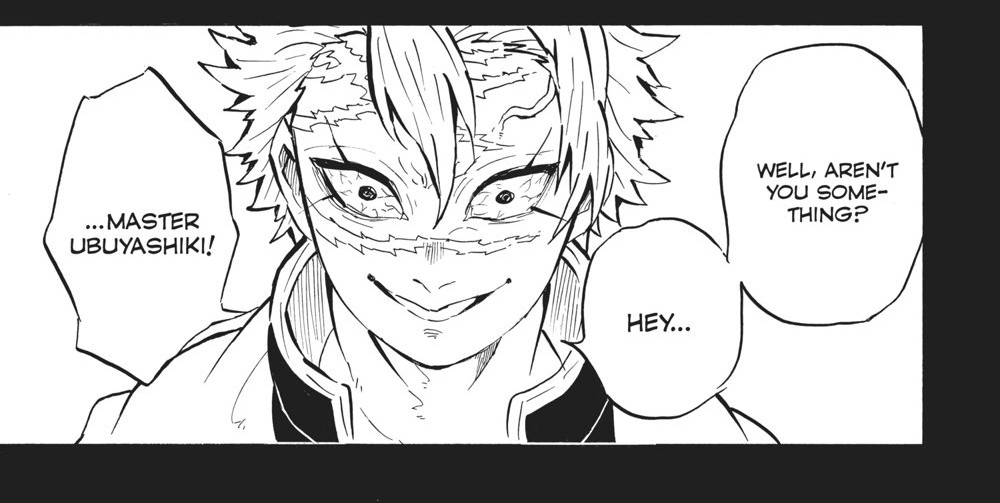
VIZ's real printed English — verified against the actual page, not against our database's automatic pairing (more on that below) — reads: "WELL, AREN'T YOU SOMETHING? HEY... ...MASTER UBUYASHIKI!" (Vol. 19, p.159.)
Grant the rendering its due: "aren't you something" is a genuine English sarcasm formula, and it lands as an insult with no scaffolding required. But watch what happens to the middle honorific. Sanemi's jab is built like a sandwich — mock-praise (いい御身分だなァ), a slur (おいテメェ), then the correct, formally respectful title (産屋敷様) — spat out like profanity. The insult isn't only what he says; it's that he keeps bowing while he says it. VIZ's "aren't you something" keeps the bite and throws away the bow.
A note on the citation. This scene sits inside a stretch of Vol. 19 where our bilingual page database's pairing slips by one page: the corpus pairs いい御身分だなァ with the English text "YOU'VE GOT IT PRETTY GOOD, DON'T YOU?", tagged to JP page 158 / EN page 158 — but the real printed EN page 158 is a different scene entirely (an unrelated fight beat), and the real English rendering of this line sits on the next image file, page 159. We confirmed this panel-for-panel: the same smirk, the same three-bubble shape, and "Master Ubuyashiki" line up exactly between Japanese page 158 and English page 159. This article quotes the corpus bytes in Sources/References (as our verification pipeline requires) but analyzes the real printed line, "WELL, AREN'T YOU SOMETHING?"
The Original
Take 御身分 apart.
身分 (mibun) is 身 (mi), "one's person, one's body" — the 身 of 身長 (shinchō, height) and 出身 (shusshin, where one is from) — plus 分 (bun), "portion, share, one's due," the same 分 as 自分 (jibun, oneself) and 十分 (jūbun, a sufficient portion). Together, 身分 is literally "the portion allotted to one's person": the fixed place assigned to someone in a hierarchy, independent of anything they did to deserve it. It is the word for the Edo-period 身分制度 (mibun seidō), the caste-like order that sorted people at birth into warrior, farmer, artisan, and merchant — a rank handed down, not earned, and mostly impossible to leave. The word never fully shed that weight; a modern 身分証明書 (mibun shōmeisho) — an ID card — is, literally, a "certificate proving one's fixed social status."
御 (go) is the honorific prefix that turns 意見 (opinion) into ご意見 (your esteemed opinion) and 住所 (address) into ご住所 (your honored address) on every form filed in Japan. Grammatically it does one job: it marks the following noun as belonging to, or associated with, someone the speaker is deferring to. It carries no sarcasm of its own — sarcasm is not a setting built into 御; it is a performance layered on top of a word that, by every rule of the grammar, should mean respect.
So いい御身分だ, word for word, says: "[you have] a fine status." Structurally it's a bare compliment — いい ("good, fine") + 御身分 (honorific noun) + だ (plain copula). Nothing in the sentence is grammatically marked as ironic; the sarcasm lives entirely in who says it, to whom, and why — the same trick as English "must be nice," except English's version carries no honorific machinery to subvert. Japanese has to actively misuse a piece of real grammar to make the joke land; English just leans on intonation.
The set phrase — いい[ご/御]身分だ(な) — is common enough to be a reflex, aimed at a sibling sleeping in while others do chores, a coworker who dodged overtime, a boss who never gets his hands dirty. It sits in a small family of similarly weaponized politeness: 貴様 (kisama), literally "your esteemed self," now a fighting word; 無礼者 (bureimono), "insolent wretch," itself a stiffly formal way to call someone rude before drawing a sword. Japanese has an entire toolkit for dressing contempt in the clothes of respect, and 御身分 belongs to it.
Grammar note: 身分 alone sits at roughly JLPT N2; 御 as a productive honorific prefix is introduced around N4–N3. The sarcastic register stacked on both is not something any JLPT level tests — it's a pragmatics skill only exposure to real, angry Japanese teaches.
VIZ's Choice
Both appearances of いい[御/ご]身分だ in the volumes we have on file:
| Vol. / p. | Japanese | VIZ English |
|---|---|---|
| 4 / 44 | いいご身分だな | YOU HAVE GOT IT SO GOOD! |
| 19 / 158 (En p.159) | いい御身分だなァ | WELL, AREN'T YOU SOMETHING? |
Same fixed idiom, same sarcastic engine, two entirely different rooms. In Volume 4, Zenitsu — freshly (and wrongly) convinced that Tanjiro has been "traveling" daily with a "cute girl" (Nezuko, boxed on his back, is not what Zenitsu thinks she is) — shrieks いいご身分だな……!!! in petty, jilted jealousy: hiragana ご, no kanji, no real weight behind the word, a comedy beat gone within a page. VIZ's "YOU HAVE GOT IT SO GOOD!" is close to perfect for this register — loud, casual, exclamatory, exactly the pitch of a boy who's just been made a fool of.
Fifteen volumes later, Sanemi reaches for the identical set phrase, spelled this time with the heavier kanji 御, aimed not at a friend's dumb luck but at the Corps' own supreme, terminally ill commander, accusing him of buying Hashira lives with his own safety. "WELL, AREN'T YOU SOMETHING?" is a solid English sarcasm formula on its own merits — but set beside "YOU HAVE GOT IT SO GOOD!", notice how close the two English lines actually sit in register, when the Japanese has traveled from a shonen jealousy gag all the way to the edge of insubordination against the one man whose word runs the entire Demon Slayer Corps. The idiom scatters the way 因縁 or 往生 scatter elsewhere in these translation notes — not because either line was misjudged, but because English's sarcasm shelf ("got it so good," "aren't you something," "must be nice") is one shallow drawer, and Japanese's equivalent drawer has a hidden compartment: the honorific.
The Gap
The status vocabulary disappears. 身分 doesn't mean "a good situation" — it means rank, a specific, historically loaded word for one's fixed place in a hierarchy. Sanemi isn't calling Ubuyashiki lucky; he's naming a structural position — "a step up, from a higher place" (一段高い所), as he puts it moments earlier — that keeps Ubuyashiki permanently clear of the blood his subordinates spill. "Aren't you something" describes a person. 御身分 describes an office.
The weaponized honorific goes untranslated. 御 is real grammar doing real work elsewhere in the same book — the same prefix that respectfully elevates 武運 into ご武運 in a farewell blessing. Sanemi hasn't invented a new word; he's pointed an ordinary tool of respect at someone and pulled the trigger. English has no honorific morpheme to hijack the same way, so the specific mechanism of the insult — over-politeness performed as contempt — has to be reconstructed from tone alone, and print can't carry tone. "Aren't you something?" works as sarcasm, but nothing on the page shows a reader that the sarcasm is built out of misapplied respect.
The honorific sandwich gets flattened. Sanemi doesn't insult Ubuyashiki once — he brackets the insult in politeness: mock-honorific (御身分) → slur (おいテメェ) → correct honorific title (産屋敷様). The structure argues its own case: I know exactly how to address you properly, and I am choosing to weaponize that knowledge. VIZ keeps "Master Ubuyashiki" — the title survives — split across three bubbles ("WELL, AREN'T YOU SOMETHING? / HEY... / ...MASTER UBUYASHIKI!") without ever cueing the reader that the first bubble and the third are running the identical ironic-respect trick.
Two occurrences, one register in English, two in Japanese. A reader meeting this idiom in Volume 4 and Volume 19 sees, in Japanese, the same set phrase stretched across its entire range, from throwaway jealousy to near-mutiny. In English, "you have got it so good" and "aren't you something" share no vocabulary at all — so the fact that Sanemi's fury is built out of the same phrase Zenitsu uses for a crush joke is invisible.
What If
- "Must be nice, having such a fine standing." — keeps "standing" as a literal seat for 身分, closer to rank/office than to dumb luck. Cost: sounds stiff and expository for a snarled mid-scene accusation.
- "Oh, must be nice, being so far above it all." — the "oh" performs the same ironic over-politeness Japanese manages with 御, and "above it all" echoes 一段高い所 (the "higher place") from two lines earlier. Cost: drops the noun 身分 entirely; rank survives only as spatial metaphor.
- "Must be nice, Master Ubuyashiki." — folds the venom directly into the honorific title he's already owed, letting "Master" carry the irony English otherwise can't prefix onto a plain noun. Cost: only works because the title sits right there; doesn't stand alone as a translation of the bubble itself.
- For Vol. 4 (Zenitsu): "Must be nice having it so good!" — nearly VIZ's actual choice, keeps the petty jealousy pitch-perfect. Cost: reusing "must be nice" for both occurrences would, ironically, track the Japanese idiom better than VIZ's real, non-matching pair — proof the scatter here isn't structurally necessary, just unclaimed.
Take-away
いい[ご/御]身分だ is Japanese doing something English sarcasm can't quite copy: taking a real honorific — the same 御 that shows genuine respect everywhere else in the language — and aiming it like a weapon. The word underneath, 身分, isn't vague fortune; it's rank, the caste-word Japan still prints on identity cards. When a translation reaches for "must be nice" or "aren't you something," the insult survives; the specific machinery of the insult — politeness turned into a blade — does not.
Three rules of thumb to carry off this page:
- When 御 or ご shows up somewhere it doesn't belong — attached to a flaw, a failure, or aimed at someone the speaker plainly resents — check for irony before you check the dictionary. Weaponized keigo is a real register, not a translation error.
- 身分 always means rank, not fortune. Wherever it appears — 身分証明書, 身分制度, 身分違い (a mismatch in social station, the classic star-crossed-lovers problem of period drama) — it names a fixed position, not a mood.
- Watch for the honorific sandwich: mock-respect, insult, correct title. It's a favorite structure in manga confrontations precisely because it proves the speaker knows the rules he's breaking.
For the same speaker's other sneer at someone else's safety, see 図体, the body-size insult VIZ turns into a simple fact. For the wider grid of pronouns and honorifics Japanese uses to draw exact lines of power — the same grid 御 is weaponizing here — see 吾輩, the grandiose "I" inside a message from this same Ubuyashiki household, おいら, the rustic "I" a trainful of country boys reach for, 小生, the bookish, self-effacing "I", and 貴方, the "you" too polite to say a name. Or browse the full Demon Slayer translation notes index.
The Japanese lines quoted above are byte-exact captures from the cited edition — Demon Slayer: Kimetsu no Yaiba Vol. 4 & 19 (Japanese) — via our bilingual page database. The English lines are verified directly against the printed VIZ Media pages (Vol. 4, p.44 and Vol. 19, p.159), since the database's automatic page-pairing slips by one page across this stretch of Vol. 19; see Sources below.