The Moment
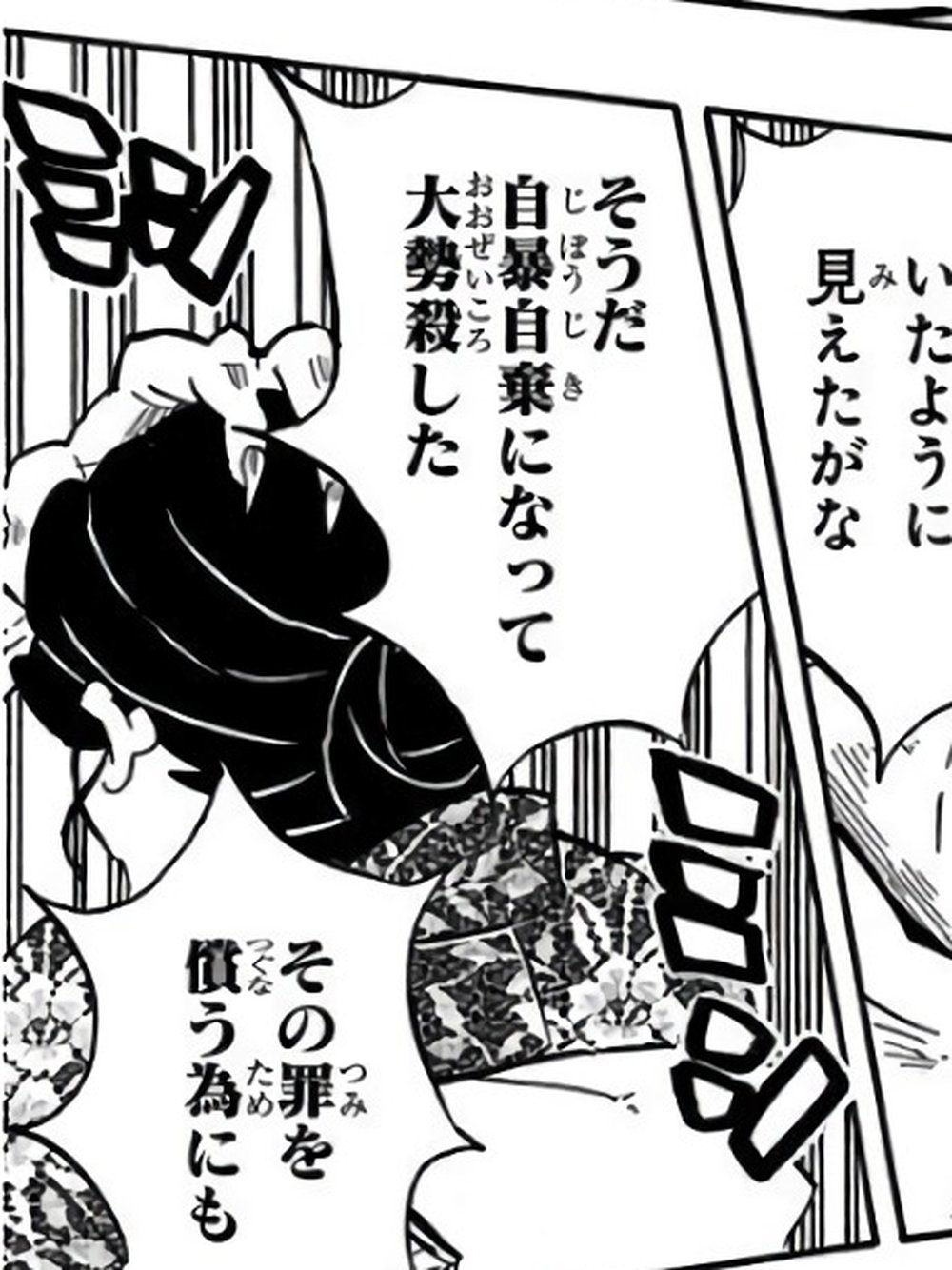
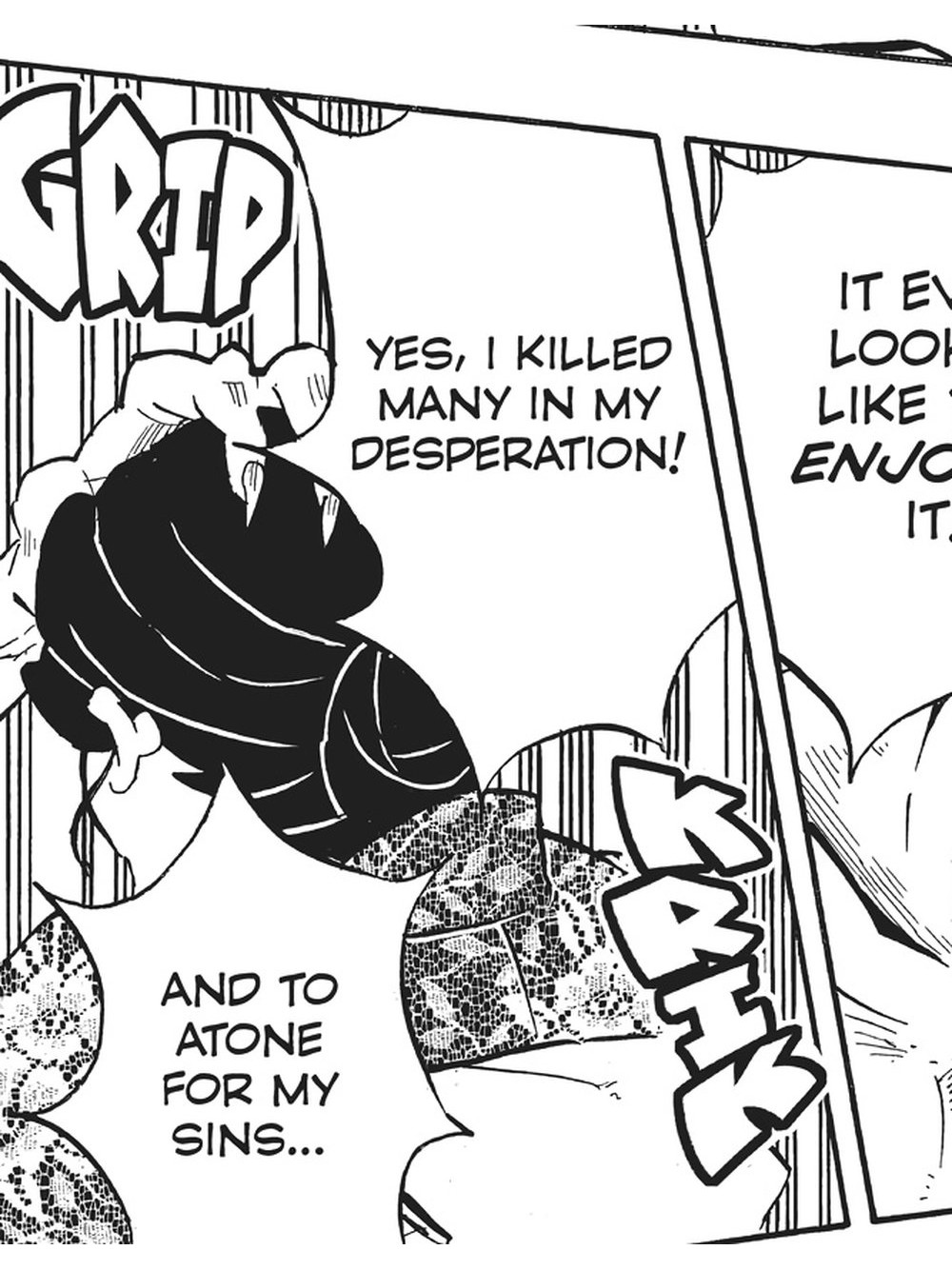
Volume 16, Chapter 138. Kagaya Ubuyashiki has just detonated his own body and his entire estate to buy the Hashira the seconds they need. In the wreckage, Tamayo — demon, doctor, and the one person in the series who has spent decades trying to undo what Muzan Kibutsuji did to her — gets close enough to force into him the drug she and Shinobu Kocho spent their lives perfecting: something that can turn a demon back into a man. She will not survive doing it. Before the poison takes hold, Muzan spends his last seconds of leverage on cruelty rather than combat, naming her outright and turning her own grief into a weapon:
「お前も大概しつこい女だな珠世」「お前の夫と子供を殺したのは誰だ?」
Omae mo taigai shitsukoi onna da na, Tamayo. Omae no otto to kodomo o koroshita no wa dare da?
"TAMAYO, YOU ARE A MOST PERSISTENT WOMAN! WHO KILLED YOUR HUSBAND AND CHILDREN?" he asks — and answers himself: 「私か?違うだろう他ならぬお前自身だ」「お前が喰い殺した」, "ME? NO! IT WAS YOU YOURSELF! ...YOU ATE THEM!" It is true, and it is the cruelest possible way to say it. Newly transformed, out of her mind with a hunger she never asked for, Tamayo killed the two people she had become a demon to keep watching over. Muzan knows exactly which knife that is.
Tamayo doesn't flinch, and she doesn't deny it. Across the next panels she answers with her own history, plain and unadorned:
「そんなことがわかっていれば私は鬼になどならなかった!!子供が大人になるのを見届けたかったからだ...!!病で死にたくないと言ったのは!!!」
Sonna koto ga wakatte ireba watashi wa oni ni nado naranakatta!! Kodomo ga otona ni naru no o mitodoketakatta kara da…!! Yamai de shinitakunai to itta no wa!!!
"IF I HAD KNOWN I'D DO THAT, I WOULDN'T HAVE BECOME A DEMON!! I WANTED TO WATCH MY CHILDREN GROW UP!! I ONLY SAID I DIDN'T WANT TO DIE FROM MY ILLNESS!!" Muzan, smiling, needles her further — 「楽しそうに人間を喰っていたように見えたがな」, "IT EVEN LOOKED LIKE YOU ENJOYED IT!" — and Tamayo gives him the one thing he wants least from her: agreement, without excuse.
「そうだ自暴自棄になって大勢殺した」
Sōda jibōjiki ni natte ōzei koroshita
VIZ's English edition prints: "YES, I KILLED MANY IN MY DESPERATION!" (Vol. 16, p.103.)
Grant the line its due before taking anything away: it is clean, it lands at full force in a single breath, and "desperation" is not a wrong word for what jibō-jiki names — a mind that has stopped weighing consequences. Muzan presses once more — 「その後も大勢人間を殺していたがあれは私の見た幻か?」, "AND YET YOU WENT ON TO KILL SO MANY PEOPLE, OR DID I IMAGINE THAT?" — and Tamayo answers with the reason she came here to die: 「その罪を償う為にも私はお前とここで死ぬ!!」, "AND TO ATONE FOR MY SINS... ...I AM GOING TO DIE HERE... ...WITH YOU!!" The drug she has just forced into him will take a hundred years to finish its work. She will not live to see a single day of it. This confession is the last full accounting she has time left to give.
The Original
自暴自棄 (jibō-jiki) is a yojijukugo built from two structurally identical two-character verbs, both opening with the same kanji: 自 (ji), "self." 暴 (bō) is the kanji of violence and exposure — the same 暴 as 暴力 (bōryoku, "violence") and 暴れる (abareru, "to rampage, run wild") — so 自暴 is literally "to do violence to one's own self," to handle one's own person roughly, with no more care than a rioter shows a stranger's shopfront. 棄 (ki) is the kanji of discarding — the same 棄 as 放棄 (hōki, "to relinquish, renounce") and 棄権 (kiken, "to forfeit, abstain") — so 自棄 is "to throw one's own self away," to write off one's own person as no longer worth protecting. Fuse the two, and the compound doesn't describe a single feeling; it stacks two separate acts of self-harm, one after the other, both aimed at the same target.
The word's real origin is older and stranger than its everyday use suggests. 自暴自棄 comes from the Confucian classic Mencius (孟子), Book 4A, Li Lou I: 自暴者不可與有言也,自棄者不可與有為也 — "one who does violence to himself cannot be reasoned with in speech; one who abandons himself cannot be worked with in action." Mencius meant two distinct moral failures, not one mood: 自暴 was arguing against propriety and righteousness — talking oneself out of virtue in conversation — and 自棄 was declaring "I am incapable of dwelling in benevolence and following the right path" — writing oneself off as constitutionally unfit for goodness. Over two thousand years the two separate character flaws fused into a single four-character compound and drifted from moral philosophy into everyday psychology. Modern 自暴自棄 no longer accuses anyone of arguing against ethics; it names the reckless, don't-care-anymore state a person falls into after being wounded past caring — the point where consequences simply stop registering.
Grammatically the word is a な-adjective/noun rather than a verb of its own: 自暴自棄な行動 ("reckless, self-abandoning behavior"), 自暴自棄になる ("to become jibō-jiki" — the phrasing both scenes in this article use), 自暴自棄だ ("to be in that state"). It never conjugates as an action in its own right, which may be exactly why fluent readers stop noticing the two separate verbs sealed inside it. Register-wise, 自暴自棄 is common, everyday-formal Japanese — the vocabulary of crime-motive reporting and self-help writing, not the archaic sword-grammar of 一刀両断 or the Buddhist liturgy of 因縁. As vocabulary it sits at JLPT N1: ordinary enough that native speakers reach for it without a second thought, built from two kanji (暴, 棄) that rarely surface outside this exact register.
VIZ's Choice
Two volumes earlier in the story's telling — though centuries earlier in the internal chronology — the same word describes a different kind of ruin. Deep in Volume 18's flashback to Upper Rank Three Akaza's human life, a dojo master lists the failings of his star student: a starving boy named Hakuji, stealing to buy medicine for a father dying of illness, who has just beaten a man half to death with fists his master taught him only to protect people:
「辛抱が足りないすぐ自暴自棄になる」
Shinbō ga tarinai. Sugu jibōjiki ni naru.
The Japanese page (Vol. 18, p.97) pairs this with Hakuji's own guilt-soaked narration a beat later — 「〝守る拳〟で人を殺した」, "with fists meant to protect, I killed someone" — but our corpus's automatic English alignment comes up empty on this stretch: Volume 18 runs its English edition one page behind the Japanese here, so JP p.97 lines up with VIZ p.98, and the machine pairing simply has nothing attached to any of these six lines. Reading the actual printed English page recovers the real rendering directly:
"...LACK FORBEARANCE. THEY SOON GIVE IN TO DESPERATION."
| Vol. / p. | Speaker | Japanese | VIZ English |
|---|---|---|---|
| 16 / 103 | Tamayo, to Muzan Kibutsuji | そうだ自暴自棄になって大勢殺した | YES, I KILLED MANY IN MY DESPERATION! |
| 18 / 97 (VIZ p.98) | Hakuji's dojo master, of Hakuji | 辛抱が足りない、すぐ自暴自棄になる | ...LACK FORBEARANCE. THEY SOON GIVE IN TO DESPERATION. |
Two occurrences, two volumes apart, two unrelated speakers describing two different people at two different points in the timeline — and VIZ reaches for the identical English solution both times. That's a different pattern than the ones this site has logged for other Demon Slayer yojijukugo: not the five-way scatter of 因縁 across the One Piece volumes, and not quite the redundant self-echo of Gyokko repeating 縦横無尽自由自在 in a single boast. This is a translator, or two translators years apart, independently arriving at the same answer for the same word — evidence that "desperation" has genuinely earned its place as jibō-jiki's working English equivalent. It is also, both times, spending the exact same coin: a doubled verb of self-ruin becomes a single noun naming a feeling.
The Gap
The doubled verb collapses into a single noun. 自暴 and 自棄 are two separate acts of self-harm stacked on top of each other — violence against the self, then abandonment of the self — and "desperation" is one noun naming one feeling. English has no single word for "to do violence to and discard oneself" the way 自暴自棄 is one word for exactly that; the architecture that makes the yojijukugo distinctive, saying the same self-directed ruin twice in two different verbs, has no equivalent shape to collapse into.
A change of state becomes a mood. 自暴自棄になる is built on になる, "to become" — it names crossing a threshold into a specific self-destructive way of acting, not simply feeling a certain way. "In my desperation" and "give in to desperation" both name an emotional cause; neither names the turn itself, the moment a person starts treating their own life as something to be thrown away. Tamayo isn't describing how she felt while killing; she's describing the person she turned into.
The self-direction goes unmarked. Both halves of 自暴自棄 open with 自 — the word insists, twice, that the violence and the abandonment point inward, at the speaker's own person. "Desperation" is directionless; it describes someone desperate to save others exactly as well as it describes someone who has given up on themselves. Nothing in the English word points the violence back at its own speaker the way 自暴自棄's doubled 自 does — which matters most in exactly the scene VIZ handles it in, a confession about what one did to one's own life before turning outward to kill.
What If
The menu, with prices:
- "YES, I GAVE UP ON MYSELF AND KILLED MANY!" — keeps 自棄's abandonment and the になる sense of crossing into a new state. Cost: drops 自暴's violence entirely; "gave up" reads passive where the killing that follows is anything but.
- "YES, I TURNED ON MYSELF, AND THEN ON EVERYONE ELSE!" — restructures the single verb into two clauses to keep the doubled direction, self then others. Cost: "turned on myself" undersells 自暴's violence, and a one-word yojijukugo becomes a two-clause sentence.
- "YES — I'D ALREADY THROWN MYSELF AWAY, SO I KILLED MANY!" — foregrounds 自棄 as a completed state that explains the killing, closer to the original's causal logic. Cost: "thrown myself away" risks reading as a suicide idiom rather than reckless, others-directed abandon.
- Keep VIZ's "desperation," restore the becoming: "YES, I'D GONE PAST CARING, AND I KILLED MANY." — Cost: "past caring" captures the threshold-crossing but loses both kanji's literal violence and abandonment without a trace.
Every option pays the same tax: 自暴自棄 packs a Mencius-grade moral verdict and a change-of-state grammar into four characters, and English's vocabulary for recklessness ("went off the deep end," "lost it," "snapped") never learned to carry a doubled self as its subject and object at once.
Take-away
VIZ's "desperation" is the right feeling wearing the wrong architecture: it keeps the mood the word points to and drops the two-verb machinery — violence, then abandonment, both turned on the self — that gets it there.
Three rules of thumb to carry off this page:
- Count the 自s. When a yojijukugo repeats a character — 自暴自棄's doubled 自, 一刀両断's 一/両 arithmetic, 縦横無尽's 縦/横 axes — the repetition is load-bearing, not decorative. It's usually the first thing a fluent single English word spends.
- Watch for になる disguised as a mood. 自暴自棄になる, 病気になる, 好きになる — になる marks a change of state, a before and an after. English translations built on adjectives and nouns ("desperate," "sick," "fond") quietly erase the crossing and keep only the far side of it.
- A shared translation across scenes is a finding, not a coincidence. When two independent VIZ renderings, years and speakers apart, land on the same word, that word has earned its place — but it's worth asking what it drops, since it drops the same thing every time.
自暴自棄 joins two other Demon Slayer yojijukugo already logged on this site: Kokushibo's mid-duel law of the blade in 一刀両断 and the count English drops, and the claim of total, inexhaustible coverage in 縦横無尽 and the four-character compass VIZ flattens to "any direction". All three idioms build their meaning from an internal doubling or count — one stroke against two halves, two named axes, two verbs of self-ruin — and all three lose that internal arithmetic in English even where, as here, the single word chosen is a genuinely good one. For the earlier chapter of the boy in this article's second scene, worked over by poverty and a dying father before he ever raised a fist in anger, see 骨を折る and the passive voice VIZ collapses into "punishment". More entries live at the Demon Slayer translation notes index.
Every Japanese and English line quoted above is a byte-exact capture from the cited editions — 鬼滅の刃 Vol. 16 & Vol. 18 (Japanese) and Demon Slayer: Kimetsu no Yaiba Vol. 16 & Vol. 18 (VIZ Media) at the corresponding panels — via our bilingual page database; see Sources below. One housekeeping note: in this stretch of Vol. 18 the English edition runs one page behind the Japanese (JP p.97 ↔ VIZ p.98), so the bilingual database's automatic alignment left 自暴自棄's second occurrence with no paired English text; the rendering quoted above — "THEY SOON GIVE IN TO DESPERATION." — was confirmed directly against the printed VIZ page.