The Moment
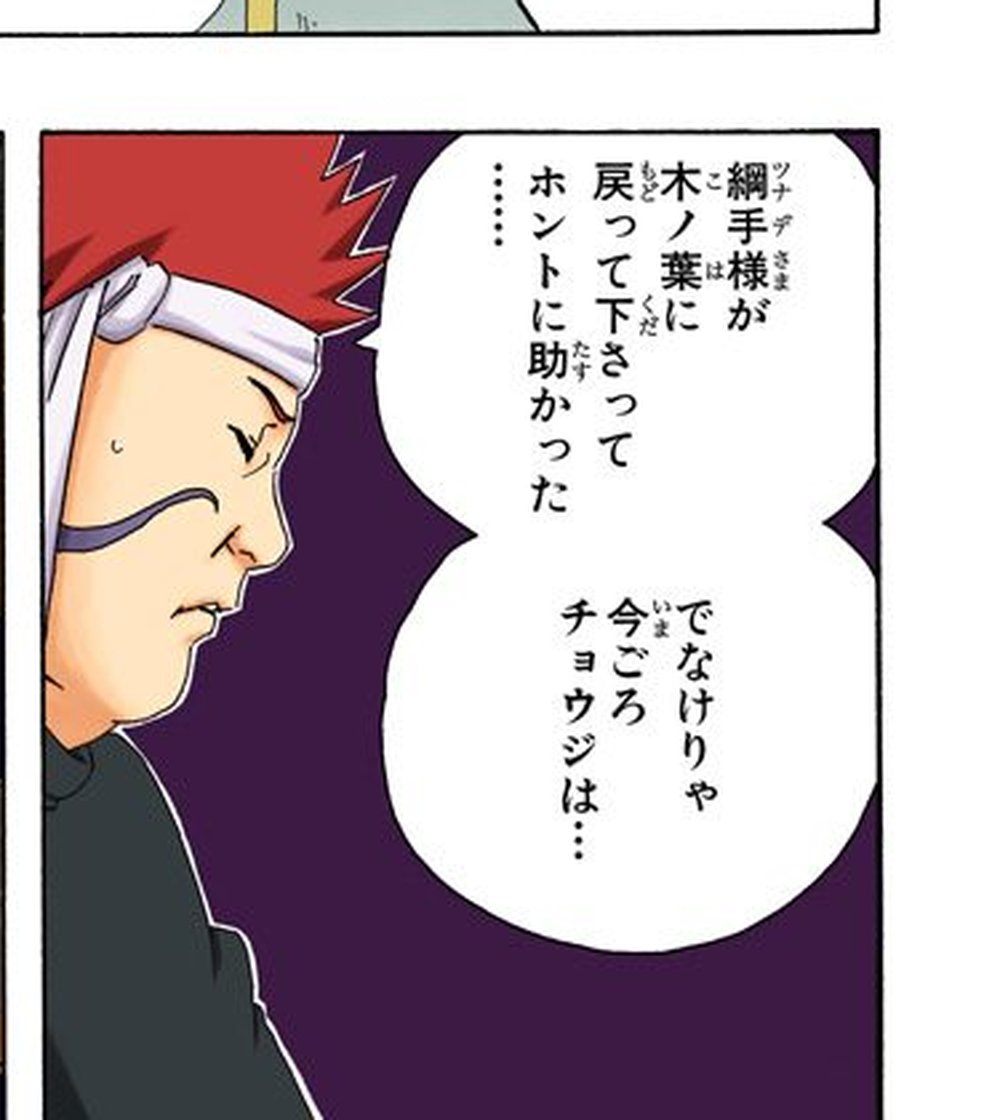
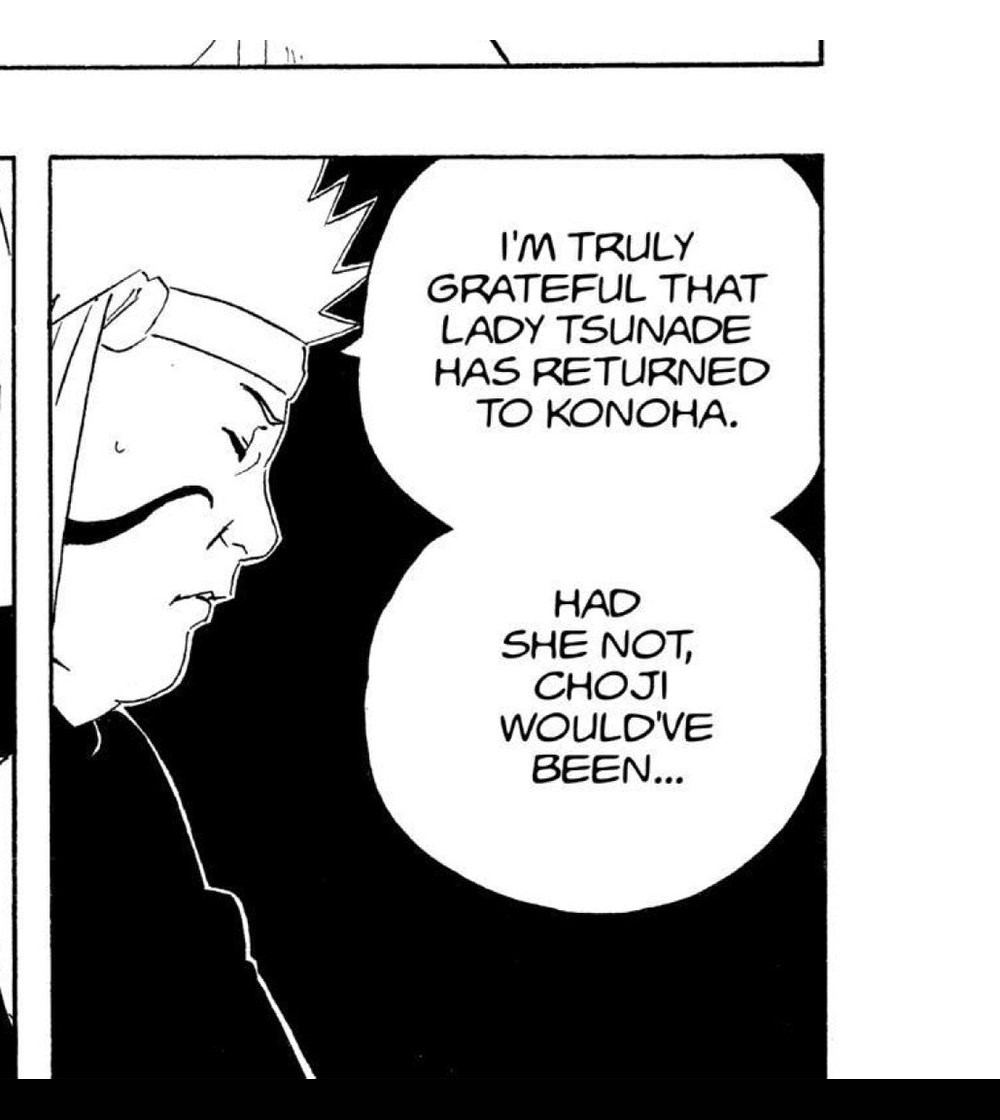
The Sasuke Retrieval mission is over, and it cost Choji Akimichi almost everything. To keep pace with Jirobo of the Sound Four, he swallowed all three of the clan's forbidden pills — the third one traditionally left unswallowed, because using it can kill the user outright — and now he lies unconscious behind a door marked 「集中治療室6」, INTENSIVE CARE WARD, ROOM 6. Outside, his father Choza waits with Ino. She exhales: 「ハア…」「良かったァ…」 — "WHEW.." / "THANK GOODNESS FOR THAT..." — then catches herself: 「じゃあまだ面会はできないんだ…」, "WE'RE NOT ALLOWED TO SEE HIM YET?" Choza answers, low: 「ああ…けどすぐに意識が戻るって綱手様が言ってくれた」 — "NO... BUT LADY TSUNADE SAID HE WOULD REGAIN CONSCIOUSNESS SOON." Then, in the next panel, still not looking up, he adds the line this article is about:
「綱手様が木ノ葉に戻って下さってホントに助かった」
Tsunade-sama ga Konoha ni modotte kudasatte, honto ni tasukatta.
VIZ's English edition prints: "I'M TRULY GRATEFUL THAT LADY TSUNADE HAS RETURNED TO KONOHA." (Vol. 27, p.15.)
Grant the rendering its due: it is warm, sincere, and completely natural English — a father's relief, plainly stated, with "Lady" doing honest work to signal Tsunade's rank. Nothing about it is wrong. But look at where the two sentences put their weight. Choza's Japanese never actually contains a word for "grateful." It doesn't need one: the gratitude is built into 下さって itself, the honorific auxiliary riding on 戻る ("to return"), which marks Tsunade's return as a kindness done, from above, for Choza's benefit — and the sentence closes not with "thank you" but with ホントに助かった, "we were truly saved," the reflexive Japanese idiom for being helped. Two grammatical devices perform the thanking; VIZ needs one invented English sentence, "I'm truly grateful," to do the job both used to share.
The Original
下さる (kudasaru) is built on 下す (kudasu) — "to hand down, to bestow from a position of authority," the same 下 that shows up in 命を下す (inochi o kudasu, "to hand down an order") and 下賜 (kashi, "a bestowal from the emperor, or from a superior, to someone below"). The kanji itself, 下, simply means "below, down" — so before the verb pictures a gift, it pictures a direction: something moving down, from a person positioned above the speaker to the speaker. Fused with the same irregular honorific conjugation that also produces なさる ("to do," honorific of する), おっしゃる ("to say," honorific of 言う), and いらっしゃる ("to be/come/go," honorific of いる・来る・行く), 下さる becomes the sonkeigo — honorific — twin of くれる, "someone gives [to me or my in-group]."
Its mirror image is 差し上げる (sashiageru): 差し, an intensifying prefix roughly "reaching out to," plus 上げる, "to raise up" — a gift lifted up by a humble giver toward a superior recipient. Between them, 下さる and 差し上げる draw the entire social ladder directly into the language's vertical vocabulary: 下 for favors that descend, 上 for favors that ascend. Japanese never lets a speaker forget which way the elevator is running.
This is bigger than one verb. Japanese runs a whole system — traditionally called 授受表現 (jujuhyōgen, "giving-and-receiving expressions") — that assigns a different verb to every combination of direction (giving vs. receiving) and rank (who's elevated, who's lowered):
| I am the giver | I am the receiver | |
|---|---|---|
| Neutral | あげる / やる (I give to an equal or someone below) | もらう (I receive) |
| I lower myself (kenjōgo) | 差し上げる (I humbly give up to a superior) | いただく (I humbly receive from a superior) |
| I elevate the other (sonkeigo) | — (nothing gives from a superior to someone else, from my point of view) | くださる (a superior kindly gives to me) |
Read the chart as one continuous idea: あげる/やる sit at the bottom rung — I give, no bowing required. 差し上げる climbs the ladder by lowering the giver. くれる is the mirror action — someone else gives, to me — and くださる is that same action climbed by elevating the giver instead. もらう and いただく close the loop on the receiving side. Six verbs, one underlying question every one of them answers before the sentence is even finished: who, here, outranks whom?
In our line, 戻って下さって is the て-form of 戻る ("to return") plus 下さる acting as a 補助動詞 (hojo-dōshi, auxiliary verb) — "[she] returned, as a kindness, [to us]." The sentence then closes with ホントに助かった, literally "[we] were truly saved/helped" — one of Japanese's most reflexive expressions of thanks, used for everything from someone holding open a door to a Hokage saving your son's life. Notice that Choza never once says ありがとう. He doesn't need to: the verb already bowed for him.
VIZ's Choice
A second sighting, thirteen volumes later, shows the same grammar in a very different mouth. Jiraiya, undercover in Amegakure, presses a local on whether the village's hidden leader, Pain, is even real. The man answers with sudden intensity:
| Vol. / p. | Speaker | Japanese | VIZ English |
|---|---|---|---|
| 27 / 15 | Choza Akimichi | 綱手様が木ノ葉に戻って下さってホントに助かった | I'M TRULY GRATEFUL THAT LADY TSUNADE HAS RETURNED TO KONOHA. |
| 40 / 179 | An Amegakure citizen | 居る居ないの問題じゃない…オレたちをいつも見守って下さっている | IT'S NOT A QUESTION OF WHETHER HE EXISTS OR NOT... HE IS ALWAYS WATCHING OVER AND PROTECTING US. |
Same grammatical marker, two opposite English strategies. For Choza, VIZ overcorrects: it manufactures an entire clause of stated feeling ("I'M TRULY GRATEFUL") to carry what the Japanese verb implied on its own. For the Amegakure citizen, VIZ does the reverse — it drops the honorific trace entirely. "HE IS ALWAYS WATCHING OVER AND PROTECTING US" is a flat declarative, indistinguishable in register from a sentence about a lighthouse or a guard dog. The devotion in 見守って下さっている — the citizen speaking of Pain the way one speaks of a patron deity — survives only in the surrounding dialogue (神と同じだ, "the same as a god," two lines earlier), not in the verb VIZ chose for it. "Protecting," meanwhile, is an addition: 見守る (mimamoru) means "to watch over, to keep an attentive eye on," closer to a parent watching a child play than a bodyguard intervening. English adds an action the Japanese doesn't quite claim, in the same sentence where it drops the one grammatical fact the Japanese does claim.
The Gap
Grammar becomes sentiment. Japanese assigns gratitude to the verb — the favor and the deference are grammatical facts, true whether or not Choza adds another word. English has no such verb, so the translator must invent a subject and a feeling from scratch: "I'M TRULY GRATEFUL." The result sounds, if anything, more personal than the Japanese — but it relocates the information from grammar (structural, always true of the verb) to sentiment (this speaker's reaction, which a reader could in principle doubt or discount).
One flat "give," no vector. English "give" works identically whether a king hands a knight a sword or a child hands a parent a crayon drawing. Japanese's giving-and-receiving system never lets a verb leave the speaker's mouth without also declaring who outranks whom. English readers get the transaction; they never get the org chart underneath it.
The system disappears as a system. Because the two occurrences on these pages land on unrelated English solutions — an invented statement of gratitude in one, a flat declarative with no honorific residue in the other — nothing on the English page signals that these are the same word doing the same grammatical work thirteen volumes apart. A Japanese reader who has met くださる once recognizes it instantly the second time; the two English sentences share no vocabulary at all.
Details get swapped instead of translated. VIZ's Amegakure line adds "protecting," a sense not really present in 見守る, while quietly dropping the one thing 下さっている actually contributes: that the watching is being framed, by the speaker, as a kindness handed down from above.
What If
No option here is free — here's the menu and its prices.
- "Lady Tsunade was good enough to come back to Konoha herself — we're truly in her debt." — "good enough to" at least gestures at a favor granted by someone with the standing to refuse it. Cost: wordier than a manga bubble comfortably holds, and "in her debt" overcorrects into a formality that doesn't match Choza's exhausted, spoken register.
- "Thank god Lady Tsunade came back to Konoha for us." — keeps the relief and gestures at "for us" as a beneficiary marker, closer to what 下さって actually encodes than a bare statement of feeling. Cost: "thank god" imports a very different, Western-secular register than the sober honorific carried by 様 and くださる.
- "That Lady Tsunade came back to Konoha herself — that's what saved him." — keeps 助かった's causal logic (her return is why Choji lived) instead of relocating the sentence into pure gratitude. Cost: the honorific favor-marking is still gone; only the causality survives.
- Keep VIZ's line, add the rank: "I'M TRULY GRATEFUL LADY TSUNADE SAW FIT TO RETURN TO KONOHA HERSELF." — "saw fit to" is one of English's few idioms that specifically implies a superior choosing, unprompted, to act in someone else's favor. Cost: "saw fit" carries a faint whiff of condescension in modern English that the Japanese, sincerely grateful, doesn't intend.
Every option trades away the same thing: English has no single verb that simultaneously (a) reports an action and (b) marks it as a favor granted by a social superior. Japanese has six such verbs, sorted by direction and rank — that is the entire point of 授受表現 — and no amount of paraphrase gets both properties into one English clause without sounding like a memo or a eulogy.
Take-away
くださる looks, on the page, like a slightly fancier way to say "give." It is actually a small, precise report: someone acted, that person outranks the speaker, and the act is being framed as a kindness. Whether the superior is a newly returned Hokage saving one genin's life or a half-glimpsed deity a whole city has never met, the verb performs the identical bow — and English, lacking the bow, has to build the sentiment back from context every single time.
Three rules of thumb to carry off this page:
- くださる always points down, never up. Find the grammatical subject of the favor — that person outranks the speaker, full stop. The direction is baked in; it isn't a matter of tone.
- Track the whole ladder, not just one verb. あげる/やる, 差し上げる, くれる, くださる, もらう, いただく are six words for what English flattens into "give" and "receive" — and each one commits to a direction and a rank the moment it leaves the speaker's mouth.
- 〜てください is this verb wearing a request's clothing. Every "please" a learner has ever said in Japanese is, underneath, the imperative of a verb that only makes grammatical sense aimed at someone whose generosity you're formally inviting.
For the rest of this hub's keigo cluster inside Naruto — the command from above a chūnin waves off as luck in 仰せ and the command English turns into coincidence, the mock-reverent "I shall humbly behold" a genin levels at a rival in 拝見 and the mock-reverent "show us", the honorific "you" a priest levels at two Akatsuki members in 貴殿 and the officer's "you", the archaic humble "I" a pack of ninja dogs never drops in 拙者 and Pakkun's samurai "I", the copula Kishimoto once gave an alternate Kakashi in ござる and the Kakashi that might have been, and the elder pronoun spoken by a toad, a man, and a fox alike in わし and the elder "I" — or browse the Naruto translation notes index. The humble mirror of this verb, 差し上げる, gets its own entry in this project's Demon Slayer keigo cluster.
Every Japanese and English line quoted above is a byte-exact capture from the cited editions — NARUTO Vol. 27 & Vol. 40 (Japanese, digital color edition) and Naruto Vol. 27 & Vol. 40 (VIZ Media) at the corresponding panels — via our bilingual page database; see Sources below.