The Moment
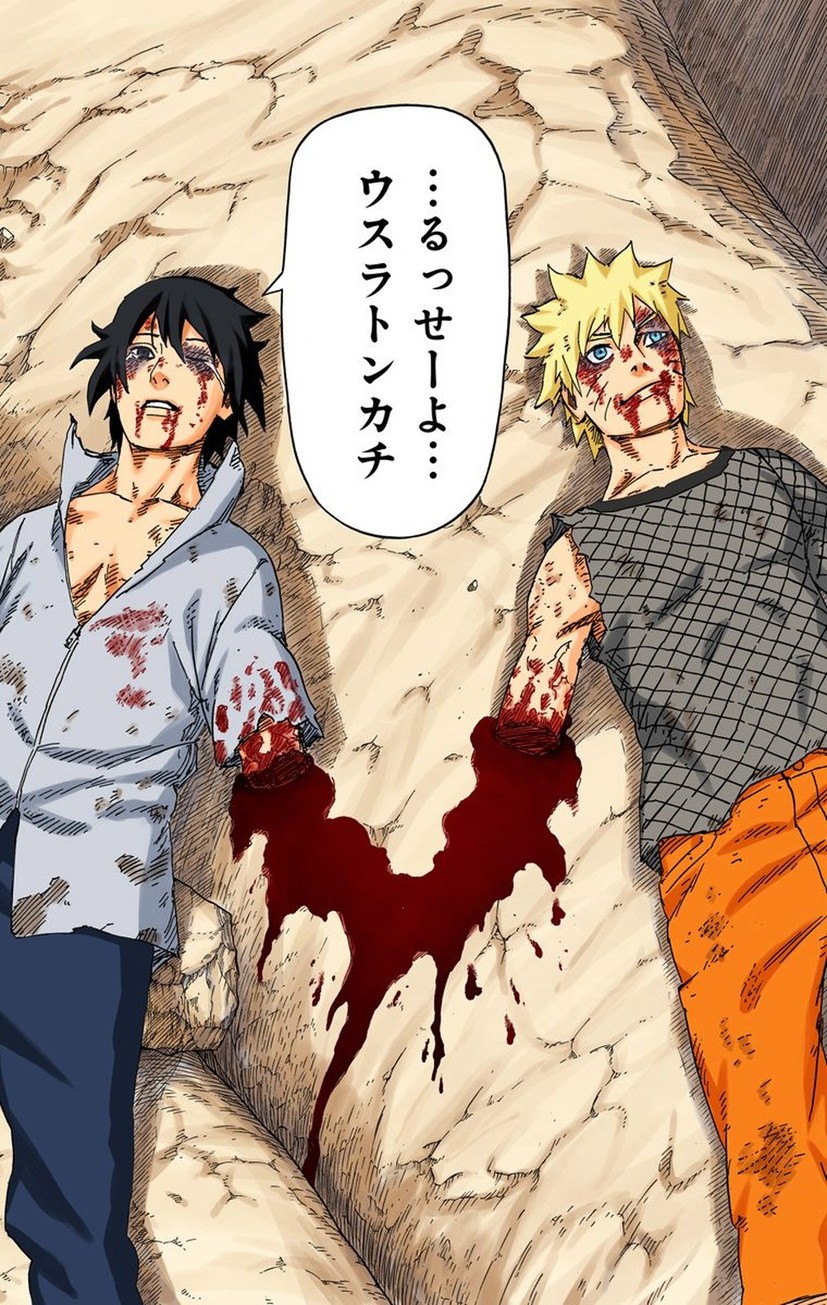
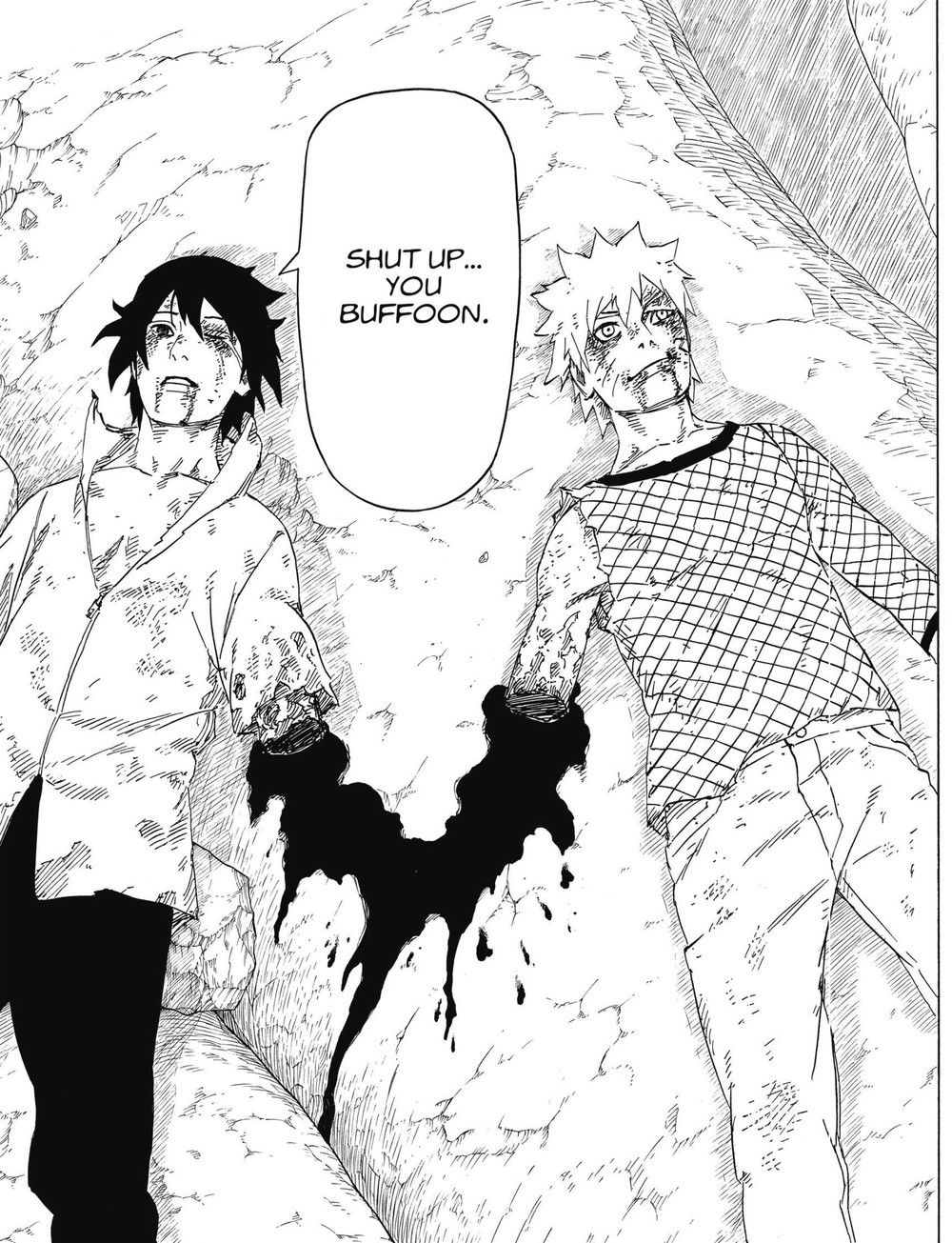
The Valley of the End, the second time. Naruto and Sasuke have just finished the fight that ends their whole rivalry — both of them threw everything they had, both of them lost an arm to the exchange, and now they lie side by side in the crater, bleeding, staring at the sky. A few pages earlier, Naruto finally said out loud what the entire series has been building toward: that he was jealous of Sasuke, not the other way around; that he acknowledges him; that whatever happens next, Naruto isn't going to let him go. Sasuke, for his part, has just told Naruto not to make him repeat himself. Then, needling one more time, Naruto turns the series' oldest joke back on its owner:
「そういやお前も意外にバカだったもんな......!」
Sōiya omae mo igai ni baka datta mon na……!
VIZ: "NOW THAT I THINK ABOUT IT, YOU WERE ALWAYS PRETTY STUPID TOO!"
A beat of silence — one small panel, just "…!", Sasuke's bloodied face turned toward Naruto's. And then Sasuke breaks it, eyes half-shut, in the last line of dialogue before the chapter ends:
「…るっせーよ…ウスラトンカチ」
…Russē yo… usuratonkachi
VIZ's English edition prints: "SHUT UP... YOU BUFFOON."
Grant the rendering its due: "buffoon" is a genuinely good choice for this exact panel. It's old-fashioned in the right way, warm under its gruffness, and it lands the scene's whole point — that the word hasn't changed, only what's underneath it has. Turn the page, and the next chapter's title card reads 「和解の印」, "Unison Sign" in VIZ's English — the reconciliation chapter. Sasuke's oldest insult for Naruto is, quite literally, the last word spoken before the story lets them make peace.
What that single good rendering can't do, on its own, is announce that this is the same word Sasuke has been throwing at Naruto since they were twelve years old, sixteen times before this one, in twelve different English costumes.
The Original
There is no kanji to unpack here, and that absence is itself the first real fact about the word: in every one of its seventeen corpus appearances, うすらとんかち is printed in katakana or hiragana, never once in kanji. It is too slangy, too informal, to have earned a settled written form — which is also why Japanese dictionaries that bother to include it at all hedge on where it comes from.
One widely cited breakdown reads it as 薄ら (usura-, "faintly, somewhat, kind of") + とんかち (tonkachi, the everyday, slightly childish word for "hammer" — the more formal term is 金槌, kanazuchi). 薄ら is a common intensifier-softener: 薄ら寒い (usura-zamui, "a bit chilly"), 薄ら笑い (usura-warai, "a faint smirk"). Under this reading, うすらとんかち is literally something like "a somewhat-dull hammer" — a tool too blunt to do the one job a hammer has. Call someone that, and you're calling them a blunt instrument: present, heavy, and useless for the point.
A second, equally cited theory skips the hammer entirely and traces とんかち back to とんちき or のろま, older words for a slow-witted fool, possibly fused with 薄馬鹿 (usura-baka, "a bit of an idiot"). Neither theory has won out; the dictionaries that carry the word mark its origin as unclear (語源は諸説あり). What both agree on is the destination: a mild, old-fashioned way of calling someone dense, filed by at least one slang glossary among words that have been fading out of everyday use since roughly the 1950s.
That detail is worth sitting with, because Kishimoto hands this decades-out-of-fashion word to a teenage prodigy as his single defining verbal tic — a small, deliberate anachronism, like a genius teenager who talks like somebody's grandfather the moment he's needling his best friend. Grammatically the word does nothing: no conjugation, no okurigana, no politeness marking. It drops into a sentence the way a name would, which is exactly what it functions as by the end of the story — less an idiom doing metaphorical work (the way 図に乗る or 手を染める do elsewhere on this hub) than a nickname that happens to also be an insult.
うすらとんかち has an unofficial companion word in this corpus, and it's worth knowing before the table below: ドベ (dobe), the flat schoolyard term for "dead last." On the very page where Team 7 first forms, Iruka-sensei reads the graduation results aloud: 「サスケは卒業生27名中一番の成績で卒業…ナルト…お前はドベ!」 — "YOU WOULD BE THE BOTTOM OF THE CLASS." / "...DUNCE!" (Vol. 1, p.95). That ranking gap — Sasuke first, Naruto last — is the soil うすらとんかち grows out of. Years later, mid-mission and mid-friendship, Sasuke reaches for the same word again, but the tone has already started to shift: 「せいぜいオレの足引っぱってくれるなよドベ!」, "JUST DON'T DRAG ME DOWN..." (Vol. 25, p.14) — teasing, not sneering. It's a preview, in miniature, of exactly the turn うすらとんかち itself completes by Volume 72.
VIZ's Choice
Every occurrence of うすらとんかち we found in the Naruto corpus, in order, speaker always Sasuke:
| Vol. / p. | Context | Japanese | VIZ English |
|---|---|---|---|
| 1 / 130 | Forest hideout, muttering about Naruto's blunder | あのウスラトンカチ | THAT FOOL... |
| 1 / 136 | Sizing up Naruto and Sakura's genjutsu attempts | ウスラトンカチが2人...(フン!) | HUH! THEY'RE BOTH BUFFOONS! |
| 3 / 83 | Tree-climbing training, Naruto hanging upside down | このウスラトンカチが... | YOU BONE-HEAD. |
| 3 / 88 | Post-training, worried needling | 動けなくなるまでやるなってーのこのウスラトンカチ | I TOLD YOU IF YOU DIDN'T TAKE A BREAK YOU'D WEAR YOURSELF OUT, YOU DOPE. |
| 3 / 152 | Land of Waves, Naruto rushing recklessly to help | こっ...このウスラトンカチ!!忍ならもっと慎重に動けェ! | Y-YOU DOOFUS! NO STEALTH... NO CAUTION... AND YOU CALL YOURSELF A NINJA?! |
| 4 / 126 | Team bickering over blame | そりゃお前だウスラトンカチ | HE WAS TALKING TO YOU, PINHEAD. |
| 6 / 15 | Searching for a missing Naruto, worried mutter | ったくウスラトンカチが.....!! | THAT IDIOT... |
| 6 / 55 | Real Sasuke asserting himself against a fake | このウスラトンカチが...... | ...YOU IDIOT! I'M ME...! |
| 7 / 106 | River training, playful | あと3回だウスラトンカチ | LET'S DO IT THREE MORE TIMES. C'MON, STUPID. |
| 8 / 99 | Prelims aftermath, relief disguised as annoyance | ったくウスラトンカチが... | SHUT UP, CLOWN. |
| 13 / 25 | Tenchi Bridge reunion, warm banter | ウスラトンカチ... | ...YOU BIG DORK... |
| 15 / 115 | Rooftop, after their first real fight | フン!このウスラトンカチが:オレに勝ちたきゃもっと修業しろ | HUMPH! YOU IDIOT... IF YOU WANT TO WIN AGAINST ME, TRAIN HARDER. |
| 15 / 136 | After the Gaara fight, quiet concern | ...ウスラトンカチ | ...IDIOT. |
| 20 / 72 | The same rooftop scene, replayed as memory | てめェ...このウスラトンカチが(何図に乗ってんだァ!!) | YOU ARE A LOSER! (WHO ARE YOU FOOLING?!) |
| 25 / 11 | Reunion after the timeskip | ウスラトンカチ | SCREW-UP. |
| 57 / 69 | Kage Summit rematch, challenge | 来やがれウスラトンカチ!! | C'MON, IDIOT!! |
| 72 / 161 | Valley of the End aftermath, final battle | ...るっせーよ...ウスラトンカチ | SHUT UP... YOU BUFFOON. |
Seventeen lines, one Japanese word, and roughly a dozen unrelated English ones: fool, buffoon, bone-head, dope, doofus, pinhead, idiot (four separate times), clown, big dork, loser, screw-up. Where 図に乗る's nine renderings at least shared a rough register (all scoldings, all sharp), うすらとんかち's scatter tracks something else entirely: a slow warming. The early volumes lean toward outright contempt or exasperation ("fool," "bone-head," "pinhead"); the middle volumes toward rivalry heat ("idiot," "loser"); and the widely spaced late-series returns — Volume 13's reunion, Volume 25's "screw-up" greeting, Volume 72's finale — toward something closer to a private joke between two people who've earned it. VIZ's individual choices track that warming reasonably well, scene by scene. What none of them can do, because each is a different word, is let a reader watching only the English text notice that it's happening — that this is the same four syllables, spoken by the same person, about the same friend, for seventy volumes.
One small, probably coincidental echo worth flagging: VIZ's very first rendering of the plural form, back in Volume 1 ("HUH! THEY'RE BOTH BUFFOONS!"), and its rendering of the Volume 72 finale ("SHUT UP... YOU BUFFOON.") are the same English word, singular and plural, seventy-one volumes and — going by real-world publication dates — roughly two decades apart. Nothing in the corpus suggests VIZ's translators were deliberately bookending the series; the more likely explanation is that "buffoon" is simply a natural, low-frequency word two different translators reached for independently. But it means that, by pure accident, English does end up with one small rhyme across the whole scatter, even if nobody planned it.
One more thing the table can't show: fandom itself has quietly done what VIZ never did. English-language Naruto communities and some subtitle tracks have, at various points, left the word untranslated — "usuratonkachi," transliterated rather than translated, treated less like an insult needing an English equivalent than like a name. That instinct, whatever its source, is arguably closer to what the word becomes by Volume 72 than any single English noun VIZ has tried.
The Gap
One nickname, a dozen unrelated solutions. VIZ's seventeen renderings — fool, buffoon, bone-head, dope, doofus, pinhead, idiot ×4, clown, big dork, loser, screw-up — share no vocabulary. A reader who only has the English text has no way to notice that Sasuke has called Naruto the identical word since they were twelve.
The blunt-tool image never crosses over. Whichever etymology is correct, うすらとんかち pictures something concrete — a hammer too dull to do its job. Not one of VIZ's twelve English words keeps any trace of tools, bluntness, or an object failing at its purpose; English's insults are all abstractions where Japanese's is, at least by one reading, a thing you could hold in your hand.
The arc has to be rebuilt from nothing. The clearest evidence in the whole series that Sasuke's coldest word for Naruto was never really about contempt — the slow drift from Volume 1's classroom sneer to Volume 72's battlefield tenderness — depends entirely on the word staying constant. VIZ's "BUFFOON" is a warm, well-chosen line in isolation; it simply can't announce that it's the same word as "BONE-HEAD" sixty-nine volumes earlier, because in English, it no longer is.
The companion insult goes untethered too. ドベ ("dead last") sets up the ranking wound that うすらとんかち keeps needling for the rest of the series, but VIZ translates ドベ three different ways as well ("bottom of the class," "dunce," a dropped reference inside "just don't drag me down"), so even the origin story loses its own repeating word.
What If
- "YOU BLOCKHEAD." — reused every time, this keeps a blunt, thing-like insult recognizable across all seventeen scenes. Cost: "blockhead" has a folksy, dated American flavor that doesn't quite match 薄ら's specific "kind of, not quite" shading, and "hammer" itself still disappears.
- Keep VIZ's scatter, but rhyme the two ends. Use "BONE-HEAD" again for the Volume 72 finale instead of "BUFFOON," bookending Volume 3's first strong occurrence. Cost: still sacrifices consistency across the middle fifteen scenes, but lets attentive readers feel the opening-and-closing echo Kishimoto built into the word's placement.
- "USURATONKACHI," left untranslated with a first-use note. The choice some fans and subtitle tracks have already made informally. Cost: unusual for a mainstream print translation to leave a common noun untransliterated — it starts reading as a proper name, which may be exactly right by the ending, but is a bigger swing than VIZ's house style usually takes.
- "DUD." — short, blunt, and about an object failing its one job, closer to the hammer image than any abstraction like "idiot." Cost: "dud" ordinarily describes objects and failed plans rather than people, so aiming it at Naruto reads slightly sideways even where it captures the underlying picture best.
Take-away
うすらとんかち isn't really an idiom asking to be decoded; it's closer to a name — the one word in the entire series that belongs to Sasuke and only means what it means because it's always aimed at the same person. Seventeen scenes, seventeen shades of feeling, and Kishimoto's whole argument is that the word itself never has to change for the person saying it to change completely.
Three rules of thumb to carry off this page:
- When an insult is really a nickname, ask who's allowed to say it. うすらとんかち only ever comes from Sasuke, only ever (almost) lands on Naruto. A translation that treats each occurrence as a fresh, independent insult misses that exclusivity — the thing that makes it intimate rather than generic.
- Track a recurring word's temperature, not just its dictionary meaning. The same four syllables cover a Forest-of-Death sneer and a bled-out battlefield murmur. If every rendering of a repeating word sounds equally sharp, or equally soft, something in between has been flattened.
- A word with a contested etymology is often doing double duty. うすらとんかち works as both "dull hammer" (an image) and "old word for fool" (a plain insult) at once — dictionaries disagreeing about which is primary is itself a clue that native speakers hear both.
うすらとんかち belongs on this hub next to Sasuke's other recorded turns of phrase — the runaway idiom in 図に乗る, which shares its exact Volume 20 rooftop-flashback panel with this word (「てめェ…このウスラトンカチが何図に乗ってんだァ!!」 is one unbroken line, split by VIZ into two unrelated English sentences), and the point-of-no-return idiom in 手を染める, spoken at this exact same Valley of the End forty-six volumes before this article's panel — the moment Sasuke's hands first "dyed" themselves with Orochimaru's power, closing here where his hands, and Naruto's, have both paid for it. For the rest of Sasuke's recorded lines, original Japanese beside VIZ's official English, see his quotes page; for more of where Naruto's translators quietly had to choose, browse the Naruto translation notes index and the full pitfalls hub.
Every Japanese and English line quoted above is a byte-exact capture from the cited editions — NARUTO―ナルト― Vol. 1–72 (Japanese) and Naruto (VIZ Media) at the corresponding panels — via our bilingual page database; see Sources below. The Volume 72 finale line spans a page-numbering seam between the Japanese and VIZ English editions (Japanese p.161 corresponds to the left half of a two-page spread VIZ prints as p.160); both pages are cited above.