The Moment
Morning at the end of Volume 4. Tanjiro, Zenitsu, and Inosuke walk out of the wisteria-crest house — the family that shelters demon slayers — and turn toward Mount Natagumo, where the next nightmare is waiting. Behind them: sparks. The tiny old landlady is striking flint over their departing backs, and Inosuke, who has never seen manners in his life, spins around with a raised fist — 「何すんだババア!!」 — "WHAT'RE YOU DOIN', Y'OLD HAG?!" Zenitsu, for once the educated one, shrieks the explanation: it's 「“切り火”だよ」, kiribi — "IT'S A RITUAL!" — 「お清めしてくれてんの!!危険な仕事行くから!!」 — "IT'S PURIFICATION BECAUSE WE'RE GOING INTO DANGER!"
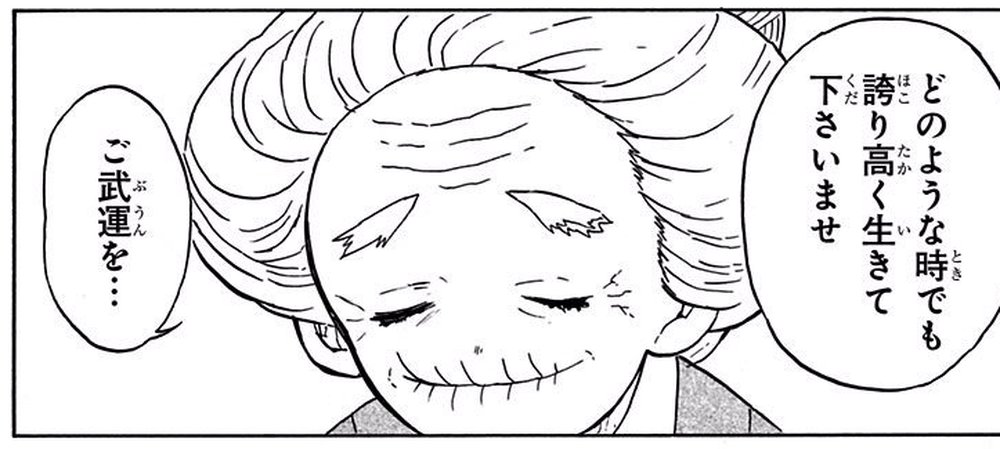
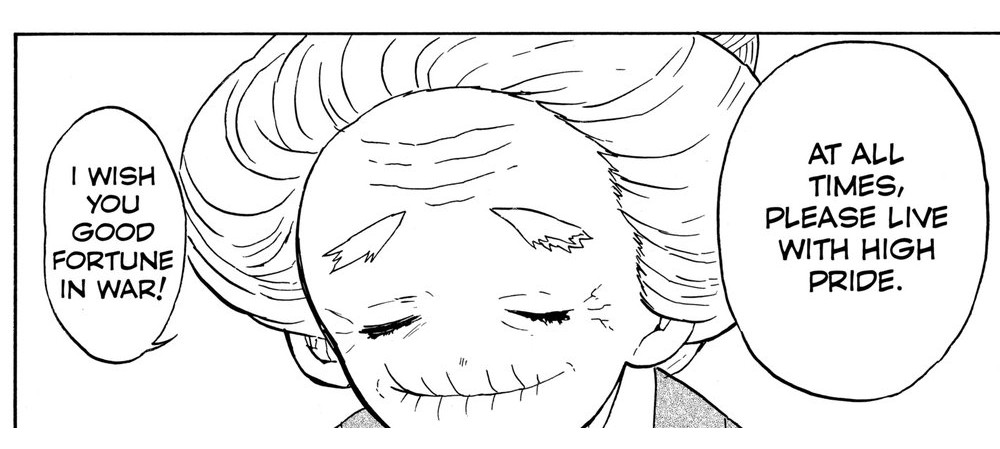
And then the old woman bows, eyes closed, and sends three children off to fight monsters with the full ceremony her generation owns:
「どのような時でも誇り高く生きて下さいませ」
Dono yō na toki demo hokori takaku ikite kudasaimase
「ご武運を…」
Go-buun o…
VIZ's English edition prints: "AT ALL TIMES, PLEASE LIVE WITH HIGH PRIDE." and "I WISH YOU GOOD FORTUNE IN WAR!" (Vol. 4, p.50).
Grant the rendering its due. Every content word of the Japanese is present and correct; the line is dignified; and — real credit — when the blessing returns as a flashback one volume later, VIZ repeats its formula word for word, so the callback lands. But set the two lines side by side and listen. The Japanese is two words and a bow, trailing off into an ellipsis, with no verb and no "I" anywhere. The English is a complete declarative sentence, first-person subject, six words long, ending in an exclamation mark. The granny murmured; the translation announces.
The Original
ご武運を comes apart into very little, and that is the point.
武 (bu) is "martial, of arms" — the 武 of 武士 (bushi, warrior) and 武器 (buki, weapon). 運 (un) is "fortune, luck" — the 運 of 運がいい ("lucky"). Together, 武運 (buun) is the fortune of arms: the share of a battle's outcome that skill cannot claim. Japanese keeps that share in its own word. Your 腕 (ude, arm — skill) is yours to train; your 武運 is dealt to you from somewhere else. The word concedes, politely, that people die in battle for reasons that have nothing to do with how good they are.
Now the grammar — or rather, the grammar that isn't there. The phrase is honorific ご + 武運 + the object particle を… and then nothing. The verb of prayer (祈る; in full courtesy お祈り申し上げます) is elided: the を dangles, pointing at a predicate too obvious and too heartfelt to pronounce, and the bow completes the sentence. This is the standard template of Japanese blessing-formulas — ご冥福を… for the dead, ご多幸を… for the living — a whole family of benedictions in which not saying the verb is the politeness. The ellipsis VIZ had to delete is not typographic decoration; it is the grammar.
The phrase has a longer, Sunday-best form: 武運長久 (buun-chōkyū), adding 長久 "long-lasting" — may your fortune in war not merely visit but stay. Praying for a warrior's 武運 is an old shrine practice (Hachiman, the god of war, was petitioned for exactly this before campaigns), and decades after this story's Taishō setting, 武運長久 would become the phrase most often inked on the yosegaki hinomaru flags and thousand-stitch belts (千人針) that saw soldiers off to the Second World War. That later history is why the words still carry a faint, solemn afterglow that no dictionary gloss captures.
In the granny's mouth the register is complete: her previous line ends in 生きて下さいませ, with the superpolite ませ of innkeepers and ladies-in-waiting. As vocabulary, 武運 sits beyond the JLPT lists — N1-plus, cultural knowledge — though the elided-blessing grammar itself is within N3–N2 reach. And the story immediately certifies how marked the word is, because Inosuke — feral, mountain-raised, never schooled — cannot parse it:
「誇り高く?ご武運?」「どういう意味だ?」
Hokori takaku? Go-buun? Dō iu imi da?
VIZ: "HIGH PRIDE?" / "WHAT'S THAT MEAN?" — and notice what's missing. We'll come back to it.
VIZ's Choice
Every appearance of 武運 in the volumes we have on file, against the official English:
| Vol. / p. | Speaker | Japanese | VIZ English |
|---|---|---|---|
| 3 / 63 | Tamayo | では武運長久を祈ります | THEN I PRAY FOR GOOD FORTUNE IN YOUR WAR. |
| 4 / 50 | the old landlady | ご武運を… | I WISH YOU GOOD FORTUNE IN WAR! |
| 4 / 50 | Inosuke, echoing | 誇り高く?ご武運? | HIGH PRIDE? |
| 5 / 48 (VIZ p.49) | the landlady, in Inosuke's flashback | ご武運を… | I WISH YOU GOOD FORTUNE IN WAR! |
Where our innen article found scatter — five scenes, five unrelated renderings — this is the opposite: a house style, applied consistently. Tamayo's formal 武運長久 in Vol. 3 and the granny's ご武運を both land in the same "good fortune in (your) war" family, and the Vol. 5 flashback repeats the Vol. 4 line verbatim, so English readers hear the callback exactly as Japanese readers do. (The other half of the flashback wobbles — "PLEASE LIVE WITH HIGH PRIDE" returns as "PLEASE LIVE YOUR LIFE WITH PRIDE" — but the war-fortune half holds.) Two quiet costs hide in the consistency. Tamayo's 長久, the "long-lasting" that turns a wish into a prayer for endurance, drops out of "I PRAY FOR GOOD FORTUNE IN YOUR WAR." And the one place the formula had to be short — Inosuke's echo — it couldn't be, because you cannot quote a six-word sentence back inside a startled little bubble. The echo got amputated instead.
The Gap
The missing verb was the register. ご武運を… has no verb and no subject; the prayer is left unsaid because saying it all would be less polite, and the bow finishes the sentence. English grammar cannot hand a verb to a bow, so the translation must manufacture a complete sentence — "I WISH YOU…" — with a first person the Japanese carefully never had. The ellipsis becomes an exclamation mark: on the printed page, ご武運を**…** turns into GOOD FORTUNE IN WAR**!** A self-effacing murmur is now a cheerful proclamation, and the granny's whole speech-act — benediction, not announcement — changes species.
The calque re-arms a fossil. No Japanese speaker hearing ご武運を computes "war," any more than an English speaker computes velocity in "Godspeed." The compound fossilized centuries ago; what's felt is solemn well-wishing with a faint clank of armor deep inside. "GOOD FORTUNE IN WAR" digs the war back up and hands it, literally, to three boys walking off to hunt demons — no fronts, no armies. A fossil should be translated as a fossil; the calque translates the fossil's skeleton.
Inosuke's echo loses its strangest word. The scene runs a controlled experiment on register: the granny speaks her era's courtesy, and Inosuke — the one character with no access to politeness — bounces the opaque words back: 誇り高く?ご武運?どういう意味だ? In English he asks only "HIGH PRIDE?" The ご武運? half of his bafflement is gone, a knock-on casualty of the six-word rendering. With it goes the story's own testimony that ご武運 is marked, old, and opaque even to a native speaker — precisely the fact a learner most needs to know about this phrase.
What If
The menu and its prices:
- "GODSPEED." — fossil for fossil: one archaic-but-living word, verbless, solemn, opaque enough that Inosuke could plausibly bark "GODSPEED? WHAT'S THAT MEAN?" Cost: it swaps the fortunes of war for God — a conversion, as our One Piece colleagues found with rest in pieces — and the martial clank is gone.
- "MAY THE FORTUNES OF WAR BE WITH YOU…" — keeps the martial luck and borrows "may," English's last living benediction grammar, ellipsis intact. Cost: long and liturgical; the innkeeper starts sounding like a herald.
- "FORTUNE IN BATTLE…" — a trailing fragment that mirrors the Japanese elision and is short enough to echo. Cost: it is not an inherited English formula, so it reads as invented — the one thing a set phrase must never sound like.
- Keep VIZ's line, restore the echo: "HIGH PRIDE? FORTUNE IN WAR?" — Cost: almost none. The calque stays, but the joke — and the register evidence — survives.
Every option pays somewhere, because English retired its send-offs-to-battle along with its bows: the slot where Japanese keeps a living shelf of verbless blessings holds, in modern English, little more than "good luck" and a wave.
Take-away
ご武運を is two words doing the work of a ceremony: an honorific, a fossilized "fortune of arms," a particle pointing at a prayer nobody needs to finish, and a bow where the verb should be. VIZ's "I WISH YOU GOOD FORTUNE IN WAR!" preserves the information and repaints the ceremony as a sentence — which is why the granny sounds translated, and why Inosuke's confusion had to be halved.
Three rules of thumb to carry off this page:
- ご + noun + を with nothing after it is a blessing, not a fragment. Supply お祈りします in your head — ご武運を, ご冥福を, ご多幸を all end in the same silent verb.
- Watch the punctuation swap. When a Japanese … becomes an English !, the words may match but the speech-act has been rewritten — a murmur made into an announcement is a register error with perfect vocabulary.
- File 武運 next to "Godspeed." Both are fossils whose insides (war, God) native speakers no longer feel. Translate the fossilization, not the fossil — and note that 武運 also sails through One Piece, where the word gets its own story another day.
For more Demon Slayer lines where the sword-era language outruns the English, see the one-stroke arithmetic of 一刀両断 and the itching arms of 腕が鳴る — or browse the Demon Slayer translation notes index.
Every Japanese and English line quoted above is a byte-exact capture from the cited editions — 鬼滅の刃 Vol. 3–5 (Japanese) and Demon Slayer: Kimetsu no Yaiba Vol. 3–5 (VIZ Media) at the corresponding panels — via our bilingual page database, and every VIZ line was re-confirmed against the printed English page. One housekeeping note: around p.48 of Vol. 5 the English edition runs one page behind the Japanese (JP p.48 ↔ VIZ p.49), so the machine-aligned database pairs the flashback ご武運を… with "IT'S NO USE... I CAN'T WIN." — which is really VIZ's rendering of Inosuke's despair from the previous Japanese page, and pairs 負けねぇ絶対負けねぇ with "THIS THING'LL KILL ME." On the printed VIZ p.49 the flashback reads "I WISH YOU GOOD FORTUNE IN WAR!" and Inosuke answers "I WON'T LOSE. I CAN'T LOSE!" — the renderings analyzed here are the ones VIZ actually printed.